Routing de dos niveles
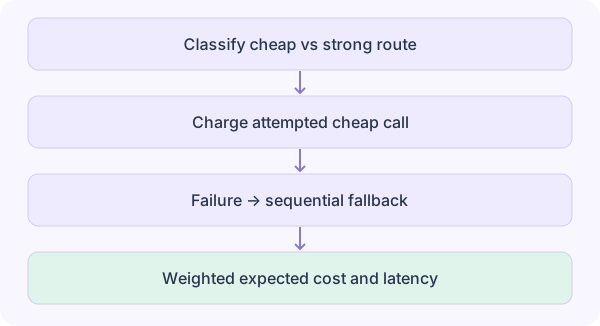
Most traffic uses the cheap path; failures add strong-model cost.
Cálculo / simulación localExperimento educativo local, sin API externa. Los datos sintéticos no son mediciones de producción.
Study guide & lesson outline
LEARNING CONTRACTUnderstand → implement → investigate
Goal: explain the mechanism in this lesson, reproduce one example and test a failure case. Reading alone does not mark mastery.
- Understand: state assumptions, shapes/units and a counterexample.
- Implement: reproduce a numerical example and inspect boundaries.
- Investigate: compare one alternative under a matched budget.
02 · Predice y configura
Las notas técnicas, los parámetros y las respuestas están actualmente en inglés.
03 · Analiza la evidencia
Métodos y referencias
Analytical expectation with user-supplied synthetic per-request prices and latencies, not current provider rates. Sequential one-time fallback; failed primary attempts are charged; fallback always succeeds. No quality prediction, queueing, correlated failures or tail-latency model.
Text / 原始公式
E[C]=s(Ccheap+f×Cstrong)+(1−s)Cstrong; E[T]=s(Tcheap+f×Tstrong)+(1−s)Tstrong
A cheaper route may violate task-quality requirements; this estimator does not measure quality.
AWS Builders Library · timeouts, retries and backoff ↗Preguntas de práctica
routing-1 / 01What does “Two-tier routing” test?
Most traffic uses the cheap path; failures add strong-model cost.
Original teaching answer / local derivation. Method reference: AWS Builders Library · timeouts, retries and backoff ↗
Abrir laboratorio →routing-1 / 02Which computation produces the result in “Two-tier routing”?
E[C]=s(Ccheap+f×Cstrong)+(1−s)Cstrong; E[T]=s(Tcheap+f×Tstrong)+(1−s)Tstrong
Original teaching answer / local derivation. Method reference: AWS Builders Library · timeouts, retries and backoff ↗
Abrir laboratorio →routing-1 / 03What is the baseline configuration for “Two-tier routing”?
{"requests":1000,"cheap":0.8,"failure":0.1,"cheapCost":0.001,"strongCost":0.02,"cheapMs":200,"strongMs":1000}
Original teaching answer / local derivation. Method reference: AWS Builders Library · timeouts, retries and backoff ↗
Abrir laboratorio →routing-1 / 04What numerical result should you check for “Two-tier routing”?
{"Expected USD/request":0.0063999999999999994,"Expected total USD":6.3999999999999995,"Expected latency (ms)":439.99999999999994,"Fallback calls":80}
Original teaching answer / local derivation. Method reference: AWS Builders Library · timeouts, retries and backoff ↗
Abrir laboratorio →routing-1 / 05How would you run a controlled comparison for “Two-tier routing”?
Keep the supplied fixture and other settings fixed; change failure. Compare expected cost, mean latency and fallback volume with observed production traces.
Original teaching answer / local derivation. Method reference: AWS Builders Library · timeouts, retries and backoff ↗
Abrir laboratorio →routing-1 / 06What failure could invalidate a conclusion from “Two-tier routing”?
A cheaper route may violate task-quality requirements; this estimator does not measure quality.
Original teaching answer / local derivation. Method reference: AWS Builders Library · timeouts, retries and backoff ↗
Abrir laboratorio →routing-1 / 07Is “Two-tier routing” a benchmark of a deployed language model?
No. Analytical expectation with user-supplied synthetic per-request prices and latencies, not current provider rates. Sequential one-time fallback; failed primary attempts are charged; fallback always succeeds. No quality prediction, queueing, correlated failures or tail-latency model.
Original teaching answer / local derivation. Method reference: AWS Builders Library · timeouts, retries and backoff ↗
Abrir laboratorio →routing-1 / 08Which evidence should you report for “Two-tier routing”?
Compare expected cost, mean latency and fallback volume with observed production traces. Export inputs, engine, result and method; distinguish synthetic fixtures from observed production data.
Original teaching answer / local derivation. Method reference: AWS Builders Library · timeouts, retries and backoff ↗
Abrir laboratorio →routing-1 / 09How can another researcher reproduce “Two-tier routing”?
Open routing-1, reset the preset, retain the exact inputs and run. The calculation is deterministic for identical inputs.
Original teaching answer / local derivation. Method reference: AWS Builders Library · timeouts, retries and backoff ↗
Abrir laboratorio →routing-1 / 10What is the next validation step after “Two-tier routing”?
A cheaper route may violate task-quality requirements; this estimator does not measure quality. Test the hypothesis on a representative held-out workload and document a baseline, success metric and stopping rule before claiming deployment readiness.
Original teaching answer / local derivation. Method reference: AWS Builders Library · timeouts, retries and backoff ↗
Abrir laboratorio →Assumptions, implementation & acceptance
Failed cheap calls are billed and fallback is assumed successful. Expected latency is serial and excludes queues; aggregate expectation is not p95 latency.
Engine formulas, scenario presets and numerical safeguards reviewed. Seeded synthetic inputs are not a production benchmark.
Before running: predict a boundary case
Most traffic uses the cheap path; failures add strong-model cost.
Hint: isolate the assumption
Keep the baseline input fixed, change one parameter or boundary, and compare both the numerical result and the claimed units. A passing example verifies this fixture only.
Minimal executable example
Save the example and linked modules in one folder. Use Node.js 22 or newer, then run node routing-1.mjs. No third-party runtime dependencies.
import {calculate,network} from './academy-core.mjs';
const params={
  "requests": 1000,
  "cheap": 0.8,
  "failure": 0.1,
  "cheapCost": 0.001,
  "strongCost": 0.02,
  "cheapMs": 200,
  "strongMs": 1000
};
const result=calculate('routing',params);
console.log(result.metrics);Test and transfer
Most traffic uses the cheap path; failures add strong-model cost.
Record input, code version, expected result and observed result in the notebook below. Then construct a counterexample that violates the assumption above and explain why the original conclusion no longer follows.
Download complete kit (.tar.gz) · Complete reference kit and regression checksPredict, test and keep evidence
Before revealing an answer, predict one result. After the exercise, record the discrepancy and a transfer test. Saved locally across language editions.
Open notebook / export / clear →The mathematical review scope is recorded per lesson. It does not establish empirical paper reproduction; report suspected errors in your notes. Review scope