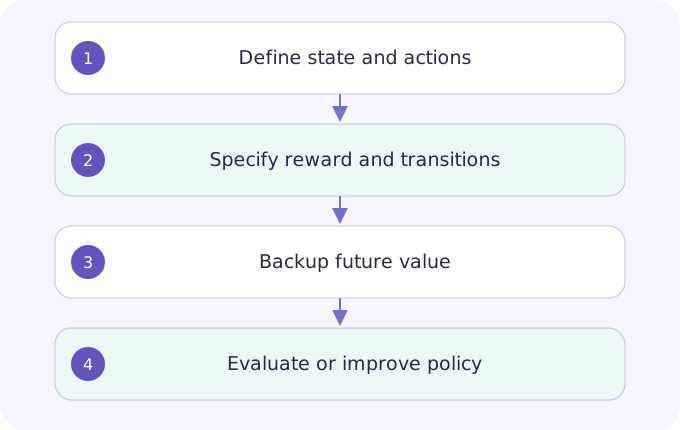
Understand: state assumptions, shapes/units and a counterexample.
Implement: reproduce a numerical example and inspect boundaries.
Investigate: compare one alternative under a matched budget.
Understand the mechanism
Specify states, actions, transition probabilities, rewards, terminal conditions and what the agent can observe. A language-model prefix can serve as a state representation; a token or tool invocation can be an action, depending on the abstraction. The Markov property is an assumption about whether the state contains enough information, not a property granted by naming a variable “state”.
Original schematic; read the steps from top to bottom. SVG ↓
Symbols and assumptions
Symbol
Meaning
γ
Discount factor
Vπ(s)
Expected return from a state under policy π
terminal
A state with no future reward in this episodic example
In a deterministic chain s₀→s₁→terminal with rewards 1 then 2, and ×2. At ,
Bellman evaluation substitutes the next state value recursively. Bellman optimality adds a maximization over next actions; do not mix policy evaluation with control.
For a stochastic transition, average over its probabilities. If half the time the next reward is 2 and half 0, the expected next reward is 1, not the maximum 2.
Experiment checkpoint
Write terminal and truncation handling explicitly. A one-step hand calculation should agree with the code.
LOCAL / SYNTHETIC / INTERACTIVE
Change one variable. Explain what moves.
Original teaching calculation, not a reproduction of the paper’s benchmark. Bars are relative within this panel; numeric values and units are authoritative.
Original exercise & analysis
Compare taking reward 2 now against waiting one step for reward 5. At they tie; at waiting gives 4.5. Explain how terminal states remove the bootstrap term.
Discounting changes the objective. Do not silently change γ between methods or bootstrap past a true terminal state. Time-limit truncation can require different handling.
Does adding a long text history guarantee the Markov property?
No. Relevant hidden environment state may remain unobserved; the resulting problem may be partially observable.
Condition the Bellman expectation on s,a. Continuing discounted tasks use 0≤γ<1; terminal value is zero. Rewards use r_(t+1), received after action a_t.
Formula conditions, units and worked arithmetic reviewed. The implementation isolates one numerical mechanism; it does not train a policy or control real hardware.
Before running: predict a boundary case
Delayed option is 4.5; makes it zero.
Hint: isolate the assumption
Keep the baseline input fixed, change one parameter or boundary, and compare both the numerical result and the claimed units. A passing example verifies this fixture only.
Minimal executable example
Save the example and linked modules in one folder. Use Node.js 22 or newer, then run node mdp-bellman.mjs. No third-party runtime dependencies.
Record input, code version, expected result and observed result in the notebook below. Then construct a counterexample that violates the assumption above and explain why the original conclusion no longer follows.
Before revealing an answer, predict one result. After the exercise, record the discrepancy and a transfer test. Saved locally across language editions.
The mathematical review scope is recorded per lesson. It does not establish empirical paper reproduction; report suspected errors in your notes. Review scope