Understand: state assumptions, shapes/units and a counterexample.
Implement: reproduce a numerical example and inspect boundaries.
Investigate: compare one alternative under a matched budget.
Mechanism & assumptions
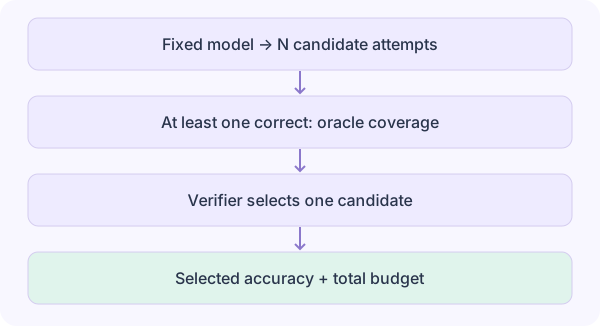
Inference-time scaling spends additional computation on a fixed model through candidate generation, revision or search. The cited paper studies prompt-dependent allocation rather than a universal rule that more tokens always help. Separate proposal quality from selection quality: an oracle that can identify any correct answer gives an upper bound that a learned verifier may not reach. Correlated candidates, reward exploitation and slow verification can erase the apparent gain. Budget generation, verification and retries together; match wall time as well as tokens when comparing methods.
Text / 原始公式
Oracle coverage = 1 − (1 − p)^N  [independent attempts]
Total cost = N·C_generation + C_verification(N)
Budget choice: maximize expected utility subject to cost ≤ B
Worked example
For independent success probability , gives coverage 0.5904; gives 0.83222784. These are probabilities that at least one correct answer exists, not that your selector returns it. If the selector finds a correct answer only 80% of the time conditional on one existing, selected accuracy at is 0.47232 under this simplified model. Perfectly correlated attempts retain coverage 0.2 regardless of N.
Implementation exercise
On a held-out problem set, compare single-shot, majority vote and verifier-selected candidates at budgets 1/2/4/8. Save every candidate and score. Report oracle coverage, selected accuracy, verifier mistakes and latency. Keep difficulty bins fixed before evaluation; do not allocate extra budget based on hidden test answers. Add a deliberately misleading high-scoring candidate to audit reward exploitation.
Deliver code, fixed seeds, raw results and one counterexample. These are experiment specifications, not executed GPU benchmarks.
Why can best-of-N get worse as N grows?
A noisy or exploitable scorer increasingly selects extreme scoring errors. Candidate quality and score calibration can shift with N. Audit selected failures and use a separately validated verifier; more search is not evidence of improved correctness.
Original teaching examples; sources checked October 2026. These are foundational mechanisms relevant to engineering, not a claim to cover every latest model.
C_verification(N) is total verification cost for N candidates. Oracle coverage assumes independent attempts with equal success probability; selected accuracy further depends on the verifier.
Formula conditions, units and worked arithmetic reviewed. The implementation isolates one numerical mechanism; it does not train a policy or control real hardware.
Mechanism map: follow the transformations from top to bottom.
Before running: predict a boundary case
Perfectly correlated attempts retain .2 coverage; the IID formula cannot be reused.
Hint: isolate the assumption
Keep the baseline input fixed, change one parameter or boundary, and compare both the numerical result and the claimed units. A passing example verifies this fixture only.
Minimal executable example
Save the example and linked modules in one folder. Use Node.js 22 or newer, then run node test-time-compute.mjs. No third-party runtime dependencies.
Perfectly correlated attempts retain .2 coverage; the IID formula cannot be reused.
Record input, code version, expected result and observed result in the notebook below. Then construct a counterexample that violates the assumption above and explain why the original conclusion no longer follows.
Before revealing an answer, predict one result. After the exercise, record the discrepancy and a transfer test. Saved locally across language editions.
The mathematical review scope is recorded per lesson. It does not establish empirical paper reproduction; report suspected errors in your notes. Review scope