Self-improving agents: reward gains are not capability gains
A research reading guide and local experiment on adaptive harnesses, reward collapse, frozen-policy comparisons and held-out evaluation.
Posted · Source check: 26 October 2026 · 15-minute lesson
Two recent preprints and one background study. These are abstract-level reading briefs, not independently reproduced paper results. The experiment below is an original synthetic teaching fixture.
Study guide & lesson outline
LEARNING CONTRACTUnderstand → implement → investigate
Goal: explain the mechanism in this lesson, reproduce one example and test a failure case. Reading alone does not mark mastery.
- Understand: state assumptions, shapes/units and a counterexample.
- Implement: reproduce a numerical example and inspect boundaries.
- Investigate: compare one alternative under a matched budget.
Start with a prediction
A coding agent’s rubric score rises from 0.70 to 0.95 after you change its instructions. Hidden-test success falls from 60% to 50%. Has the agent improved? Write your criterion before looking at the experiment.
Prerequisites: sample means, variance, evaluation splits and basic RL rewards. By the end, you should distinguish policy updates from runtime updates, detect a reward group with no relative signal, and design a comparison that separates better scoring from better task completion.
Three papers, three different meanings of improvement
HarnessRL: Co-Evolving Policies with a Just-in-Time Training Harness for Open-Ended RL
Paper version: 2610.26426v1 · Version date:
HarnessRL adapts task sampling, rollout guidance and rubric criteria as the policy changes. Its proposed critic evaluates harness changes against the current frozen policy. The paper distinguishes rewards that provide little discrimination from rewards that misrepresent answer quality. This is a training-time proposal, not proof of unrestricted recursive self-improvement.
Read critically: Which interface changed, and can an independent evaluator still detect better answers?
Self-Improving Agents with World Model Predictive Paths
Paper version: 2610.28945v1 · Version date:
This test-time framework compares imagined consequences of multiple actions using a world model and MPPI-inspired weighting. Separate experience memories support planning and observation prediction. The abstract reports experiments in ALFWorld and ScienceWorld; these language-environment results do not establish real-robot transfer. The authors state that code will be released.
Read critically: Does imagined progress predict actual progress, especially on unfamiliar states?
Multi-Harness Reinforcement Learning for Coding Agents: Training Gains and Harness Dependence
Paper version: 2609.04518v2 · Version date:
Background reading, not a new release this week. This controlled study compares within-harness and cross-harness reward normalization from a shared Qwen3-8B checkpoint and replay data. It reports modest source-harness gains without consistent improvements on an unseen harness. Execution-interface variation is larger than the measured training gains in this study.
Read critically: Does a gain survive an unseen execution interface at the same evaluation budget?
The engineering distinction
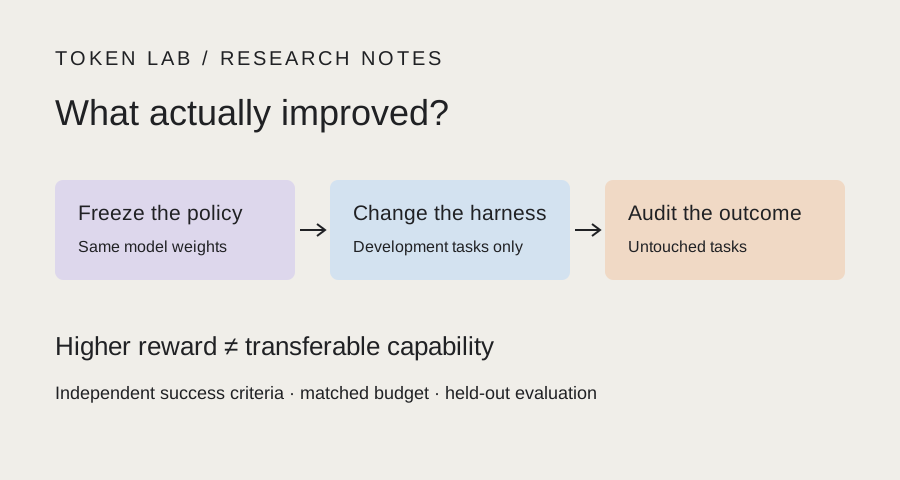
In a coding assistant, a harness change might improve how test output is retained between turns. A policy update changes the model’s parameters. A judge update changes what receives reward. These interventions can all raise a dashboard number, but they support different conclusions. Product behavior alone does not reveal which method a proprietary assistant uses.
| Change | Hold fixed | Question |
|---|---|---|
| Harness | Model checkpoint and evaluator | Does better context or tool handling improve completion? |
| Policy | Harness and evaluator | Do learned weights improve completion? |
| Evaluator | Saved outputs and independent labels | Does the score better track correctness? |
One numerical mechanism: reward discrimination
For a group of G scalar rewards, use population variance. All quantities below are dimensionless. This is a teaching normalization, not a complete GRPO loss: it omits token-level likelihood ratios, clipping and regularization.
For rewards [0, 1], the mean is 0.5, variance 0.25 and advantages [−1, 1]. For [1, 1, 1], variance is zero; our implementation returns zero rather than dividing by zero. This says there is no within-group relative signal, not that every answer is good. Uniformly incorrect answers have the same problem. A variance floor can stabilize near-zero variance but does not create useful ranking information.
Run the local experiment
Predict which candidate is selected. The baseline solves 6/10 development tasks in 20 calls. A proxy-optimized candidate solves 5/10 with a higher rubric score. A second candidate solves 8/10 in 20 calls. Our deliberately simple development gate requires strictly more correct tasks and no extra calls. It is not a significance test.
Ready. Everything runs locally; no model calls or uploads.
Expected: seven PASS checks. Reject the proxy-only improvement, accept the second candidate on development, then observe 6/10 versus 6/10 on the separate synthetic audit. The fixture demonstrates the logic of a failure, not its frequency in real agents.
Download complete implementation · Node.js 22+, no dependencies, no randomness or seed needed.
node --input-type=module -e "import {run} from './adaptive-harness.mjs'; console.log(run())"Full implementation and assertions
// Original deterministic teaching fixture. No model training or external calls.
export function advantages(rewards){
 if(!rewards.length||rewards.some(x=>!Number.isFinite(x))) throw Error('Finite nonempty rewards required');
 const mean=rewards.reduce((a,b)=>a+b,0)/rewards.length;
 const variance=rewards.reduce((a,b)=>a+(b-mean)**2,0)/rewards.length;
 return rewards.map(x=>variance===0?0:(x-mean)/Math.sqrt(variance));
}
export function decide(base,candidate){
 for(const r of [base,candidate]) if(!Number.isInteger(r.correct)||!Number.isInteger(r.n)||r.n<1||r.correct<0||r.correct>r.n||!Number.isFinite(r.calls)||r.calls<0) throw Error('Invalid measurement');
 if(base.n!==candidate.n) throw Error('Use matched tasks');
 return candidate.correct>base.correct&&candidate.calls<=base.calls;
}
export function run(){
 const checks=[];const check=(name,ok)=>{if(!ok)throw Error(name);checks.push('PASS: '+name)};
 check('uniform rewards have no relative signal',advantages([1,1,1]).every(x=>x===0));
 const a=advantages([0,1]);check('population normalization',a[0]===-1&&a[1]===1);
 const baseline={n:10,correct:6,calls:20};
 const scoreHack={n:10,correct:5,calls:20,proxy:0.95};
 const candidate={n:10,correct:8,calls:20,proxy:0.8};
 check('reject proxy-only gain',!decide(baseline,scoreHack));
 check('accept development improvement at matched budget',decide(baseline,candidate));
 check('reject extra compute',!decide(baseline,{...candidate,calls:21}));
 let rejects=0;for(const bad of [[],[NaN],[Infinity]])try{advantages(bad)}catch{rejects++}
 check('reject invalid reward vectors',rejects===3);
 // Only inspected after selection: development success does not guarantee transfer.
 const heldOut={baselineCorrect:6,candidateCorrect:6,n:10};
 check('no demonstrated held-out gain',heldOut.baselineCorrect===heldOut.candidateCorrect);
 return {checks,baseline,scoreHack,candidate,decision:'candidate selected on development only',heldOut,conclusion:'A development gain is not evidence of transferable capability.'};
}
From fixture to a fair research experiment
- Pre-register task success and the budget: model tokens, tool calls, wall time and any evaluator calls. Equal tool counts alone do not imply equal compute.
- Freeze a model checkpoint. Run baseline and candidate on matched development tasks. Keep evaluator version and task fixtures constant.
- Inspect failure cases, then select the configuration. Include a no-change control and an evaluator-only change.
- Lock the configuration before opening held-out tasks. Record paired per-task outcomes and repeat stochastic runs with declared seeds.
- Report confidence intervals, failures by category and transfer to a different harness. An improvement on ten tasks is too weak for a general capability claim.
A useful ablation matrix crosses two model checkpoints with two harnesses under one frozen evaluator. This separates checkpoint effects, harness effects and their interaction. If you repeatedly tune against the audit set, retire it and obtain a fresh audit set. Do not relabel the same exposed data “held out.”
Interview practice · original Token Lab questions
Why can all-one rewards be unhelpful?
Hint: Consider within-group variance.
Answer and analysis
Every centered reward is zero. Relative normalization supplies no preference signal, even if absolute task quality looks high. Check task difficulty and the evaluator before changing the optimizer.
Does testing a change on a frozen policy prove the model learned?
Hint: Which parameters changed?
Answer and analysis
No. It isolates an effect of the surrounding harness at that checkpoint. A learning claim requires comparing updated weights under a controlled harness and evaluator.
Why can better predicted action costs hurt a deployed agent?
Hint: Separate model predictions from environment outcomes.
Answer and analysis
A planner can exploit world-model errors. Audit predicted versus observed progress and risk, compare an equal-budget reactive baseline, and test out-of-distribution states.
How would you test transfer across coding interfaces?
Hint: Distinguish source interfaces from the final interface.
Answer and analysis
Hold model, task set, tools and budget definitions fixed where possible. Reserve an unseen harness for final evaluation, report interface-specific failures, and avoid choosing the winning model on that final result.
Transfer exercise
A candidate solves 8/10 tasks but uses 30 calls instead of 20. Modify the fixture to compare success under a fixed total-call budget. Explain why simply dividing success rate by calls can reward a system that stops too early.
Continue the learning path
First: implement a bounded agent harness → Next: verification and inference budgets → RL knowledge library
Source scope: the three linked arXiv abstracts and version histories were checked on 26 October 2026. No conference acceptance or independent reproduction is claimed. Read the full papers before reproducing their training protocols.