Does RL actually improve capability?
Make a falsifiable claim with independent evidence.
Detailed technical articles are available in English and Chinese. This locale shows the English article with localized navigation.
Study guide & lesson outline
LEARNING CONTRACTUnderstand → implement → investigate
Goal: explain the mechanism in this lesson, reproduce one example and test a failure case. Reading alone does not mark mastery.
- Understand: state assumptions, shapes/units and a counterexample.
- Implement: reproduce a numerical example and inspect boundaries.
- Investigate: compare one alternative under a matched budget.
Understand the mechanism
Define capability in observable terms: task success on unseen inputs, robustness to perturbations, calibration, cost or constraint satisfaction. Match inference budgets before comparing training recipes. Reward optimization, preference win rate and factual correctness are different endpoints. Include failure slices, uncertainty and a baseline that received a fair tuning budget.
Text / 原始公式
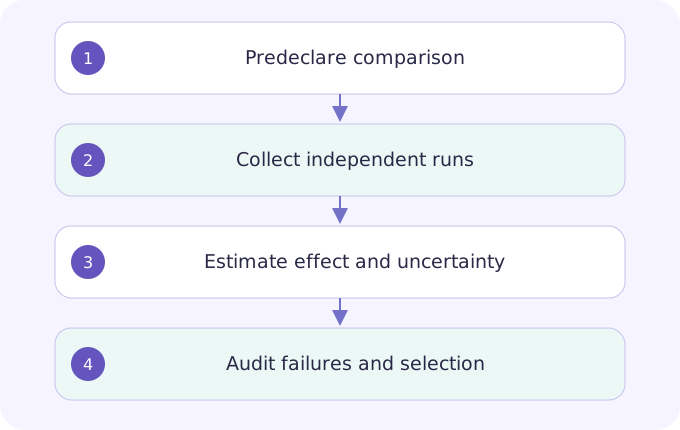
Claim → held-out tasks → matched budgets → uncertainty → failure audit
Report both pass@1 and any best-of-k protocol separately.
Mechanism map & worked derivation
| Symbol | Meaning |
|---|---|
| Scientifically matched pair difference | |
| s_d | Sample standard deviation of differences |
| n | Independent pairs, not repeated calls on one item |
- Use differences [1,2,3]. Their mean is 2 and sample standard deviation is 1. The estimated standard error is 1/√3≈0.577350.
- Multiplying by 1.96 gives an illustrative normal half-width 1.131607. With only three pairs and unknown variance, that normal approximation is weak; do not report it as a reliable small-sample interval.
- Bootstrapping should resample whole independent units. If several rows belong to one task or user, consider cluster-level resampling rather than pretending rows are independent.
A small interval can coexist with a biased experiment. Check leakage, selection and tuning budgets separately.
Original exercise & analysis
Write a preregistration for one RL improvement claim: primary metric, minimum useful effect, dataset split, training budget, inference budget, seed count and stopping rule. Prepare a table of alternative explanations and the control that would rule each out.
Passing a reproduction checklist is not reproducing a result. A model can game a verifier or improve average performance while failing an important subgroup.
What evidence would make you reject your improvement claim?
A matched-budget baseline erasing the gain, contamination, wide uncertainty around a negligible effect, or a critical regression can each invalidate the proposed conclusion. Specify these conditions before running the study.