Industry AI briefing: restricted models, enterprise actions and local speech
October 28, 2026: Google DeepMind, OpenAI and NVIDIA announcements, availability caveats and practical evaluation questions for AI engineers.
Posted · Updated
Coverage: announcements dated October 28, 2026, reviewed in America/Los_Angeles. Sources do not consistently expose publication times, so this is a calendar-day digest rather than an exact rolling 24-hour feed. Company claims are attributed; engineering implications are Token Lab analysis. No independent model or hardware benchmark was run.
Gemini 4 Carbon: capability claims meet a restricted rollout
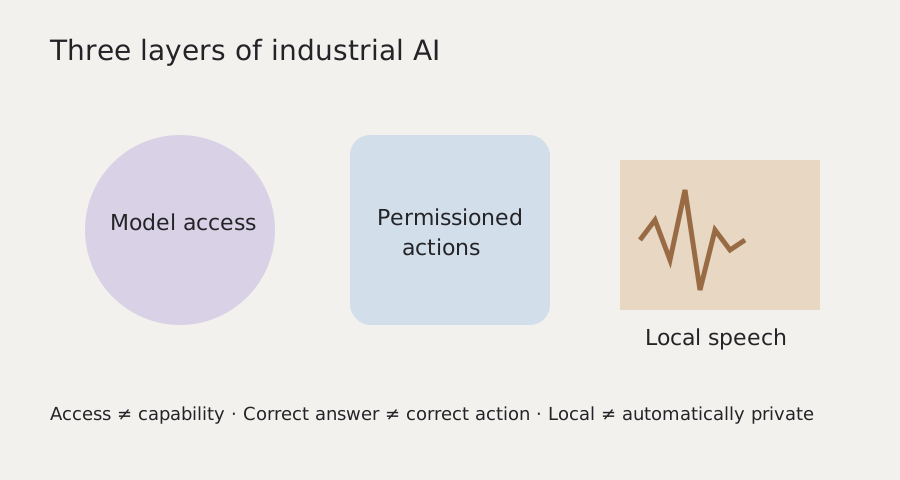
Google announced Carbon on October 28, emphasizing cybersecurity and long-horizon engineering. Initial access is limited to selected cyber defenders and trusted partners; general developer availability is still forthcoming. Benchmark and internal safety improvements are vendor-reported, not reproduced by Token Lab.
Engineering implication — our analysis
Before changing a model route, verify access, guardrail configuration and task-level performance at equal budgets. A stronger benchmark score is not a deployment readiness certificate.
Enterprise agents move from answers toward permissioned actions
The October 28 announcement expands workflow integration across ChatGPT, Codex and ServiceNow. The MCP plugin is available now, while enhanced features, voice, security capabilities and the Workflow Factory integration have separate future timelines. Existing ServiceNow business rules and permissions govern available actions.
Engineering implication — our analysis
For an incident-management agent, test authorization, idempotent updates, approval gates and audit trails separately from answer quality. A partnership announcement does not establish lower incident resolution time.
Local speech models expand the on-device agent stack
NVIDIA’s October 28 update introduces open-weight Nemotron 3.5 Transcribe for transcription, speaker attribution, translation and audio questions. The announcement also describes LFM3 support and agent tooling for RTX Spark. Shipping features and upcoming updates are mixed in the release and should be checked individually.
Engineering implication — our analysis
Evaluate word error rate, speaker attribution, latency and peak memory on representative recordings. Open weights permit deployment choice; privacy still depends on the application, telemetry and actual data path.
Turn the news into a small evaluation
Choose one real task, write a success criterion and freeze a small evaluation set before changing a model or runtime. Record model version, permissions, tool calls, wall time, cost and the independent outcome. Compare like-for-like budgets. For a voice workflow, evaluate recognition and downstream action correctness separately.
Interview prompt: an agent correctly identifies an incident but writes the wrong record. Is that a reasoning failure or an execution failure? Trace identity resolution, tool arguments, authorization, record version and the returned action receipt before choosing a fix.
Coverage gaps: no verified same-day robotics or recursive self-improvement announcement is included. Earlier releases are not relabeled as today’s news. This digest is selective, not an exhaustive company ranking.