1. Does a green manifest check prove reproducibility?
Show answer & scoring criteria
No. It checks internal declarations. Verify code, data versions, environment, execution and agreement with the target protocol.
Record a falsifiable hypothesis, inspect controls and export a reviewable experiment report.
Local calculations and synthetic examples. No paid API or live-model benchmark.Goal: explain the mechanism in this lesson, reproduce one example and test a failure case. Reading alone does not mark mastery.
Prerequisites · Experimental controls, versioning, paired metrics.
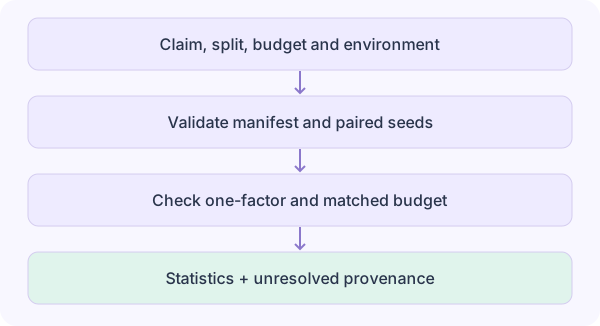
A reproduction claim needs a traceable relationship between the paper, implementation, data and observations. The workbench checks declared fields, budget equality and top-level changed configuration keys. It never certifies that the declarations are true.
Hypothesis → baseline → one-factor intervention → paired runs → uncertainty → limitations
Required: paper, hypothesis, metric, direction, threshold, datasetVersion, splitHash, baseline, treatment, runs
Common pitfall: Do not mark a study as successfully reproduced because a checklist is green. Compare the actual protocol and observations with the original claim.
A baseline and treatment share seed IDs [1,2,3,4,5]. How many paired run observations enter the analysis?
Five pairs, not ten independent paired observations.
Replace the demo metadata with actual identifiers, paste paired seed results, then introduce a second configuration change or budget mismatch. Export the report and explain which concerns remain manual.
Deliver: input configurations, exported results, controlled variables, observations, alternative explanations and the next validation step.
Equal step counts need not imply equal compute. Hashes and commit IDs are only declarations here. Read the paper and inspect the actual split membership before claiming successful reproduction.
Run the experiment to see evidence.
Only compare runs with controlled inputs. Exports include inputs and methods.
Self-assessment: explain the mechanism, identify assumptions, and propose a discriminating test. No automatic LLM grading.
No. It checks internal declarations. Verify code, data versions, environment, execution and agreement with the target protocol.
State the attempted protocol, deviations, budget, uncertainty and failed hypotheses; do not hide null results or assume the original claim is false.
Reproducibility repeats a result under a specified setup; generalization tests transfer to different data, environments or tasks.
No paper fetch, cloud training or provenance verification. The included runs are synthetic. Nested configuration differences are counted by top-level key; several causal changes can hide inside one key. Manual review remains required.
arXiv:1709.06560 · 2017
Henderson et al. · Year denotes first arXiv submission
Read: Sources of experimental variability and reporting recommendations.
Reading checkpoint: Separate randomness from implementation and tuning differences. RL findings motivate controls; do not blindly transfer its numerical results to LLMs.
@misc{arxiv170906560,
  title = {Deep Reinforcement Learning that Matters},
  year = {2017},
  eprint = {1709.06560},
  archivePrefix = {arXiv},
  url = {https://arxiv.org/abs/1709.06560}
}
arXiv:1909.03004 · 2019
Dodge et al. · Year denotes first arXiv submission
Read: Expected validation performance under a computational budget; model selection.
Reading checkpoint: Report search space, trial count and selection rule alongside the final score.
@misc{arxiv190903004,
  title = {Show Your Work: Improved Reporting of Experimental Results},
  year = {2019},
  eprint = {1909.03004},
  archivePrefix = {arXiv},
  url = {https://arxiv.org/abs/1909.03004}
}No paper fetch, cloud training or provenance verification. The included runs are synthetic. Nested configuration differences are counted by top-level key; several causal changes can hide inside one key. Manual review remains required.
Objective, derivatives, worked examples and implementation reviewed. A passing finite-difference or manifest check is not a paper reproduction certificate.
Replace the demo metadata with actual identifiers, paste paired seed results, then introduce a second configuration change or budget mismatch. Export the report and explain which concerns remain manual.
Keep the baseline input fixed, change one parameter or boundary, and compare both the numerical result and the claimed units. A passing example verifies this fixture only.
Save the example and linked modules in one folder. Use Node.js 22 or newer, then run node paper-reproduction.mjs. No third-party runtime dependencies.
import {runPhd} from './phd-core.mjs';
const params={
  "manifest": "{\n  \"paper\": \"https://arxiv.org/abs/2106.09685\",\n  \"hypothesis\": \"Increasing rank improves a held-out metric at matched training budget.\",\n  \"metric\": \"accuracy\",\n  \"direction\": \"higher\",\n  \"threshold\": 0.01,\n  \"datasetVersion\": \"toy-v1\",\n  \"splitHash\": \"demo-split-not-a-real-hash\",\n  \"baseline\": {\n    \"config\": {\n      \"rank\": 2,\n      \"learningRate\": 0.1\n    },\n    \"budget\": 1000,\n    \"budgetUnit\": \"optimizer steps\"\n  },\n  \"treatment\": {\n    \"config\": {\n      \"rank\": 4,\n      \"learningRate\": 0.1\n    },\n    \"budget\": 1000,\n    \"budgetUnit\": \"optimizer steps\"\n  },\n  \"environment\": {\n    \"codeCommit\": \"fill-with-real-commit\",\n    \"runtime\": \"record exact runtime\",\n    \"hardware\": \"record device\"\n  },\n  \"runs\": [\n    {\n      \"seed\": 1,\n      \"a\": 0.72,\n      \"b\": 0.75\n    },\n    {\n      \"seed\": 2,\n      \"a\": 0.74,\n      \"b\": 0.76\n    },\n    {\n      \"seed\": 3,\n      \"a\": 0.71,\n      \"b\": 0.75\n    },\n    {\n      \"seed\": 4,\n      \"a\": 0.75,\n      \"b\": 0.76\n    },\n    {\n      \"seed\": 5,\n      \"a\": 0.73,\n      \"b\": 0.76\n    }\n  ]\n}"
};
console.log(runPhd('paper-reproduction',params));Replace the demo metadata with actual identifiers, paste paired seed results, then introduce a second configuration change or budget mismatch. Export the report and explain which concerns remain manual.
Record input, code version, expected result and observed result in the notebook below. Then construct a counterexample that violates the assumption above and explain why the original conclusion no longer follows.
Download complete kit (.tar.gz) · Complete reference kit and regression checksBefore revealing an answer, predict one result. After the exercise, record the discrepancy and a transfer test. Saved locally across language editions.
Open notebook / export / clear →The mathematical review scope is recorded per lesson. It does not establish empirical paper reproduction; report suspected errors in your notes. Review scope