RAG chunking lab
Explore Unicode-safe chunk boundaries, overlap, and exact text-token counts.
Study guide & lesson outline
LEARNING CONTRACTUnderstand → implement → investigate
Goal: explain the mechanism in this lesson, reproduce one example and test a failure case. Reading alone does not mark mastery.
- Understand: state assumptions, shapes/units and a counterexample.
- Implement: reproduce a numerical example and inspect boundaries.
- Investigate: compare one alternative under a matched budget.
01Configure
02Add your input
Choose settings, load an example, or paste your own input.
03Inspect results
Choose settings, load an example, or paste your own input.
The display may be truncated; the exported JSON report contains all computed results.
How to interpret this
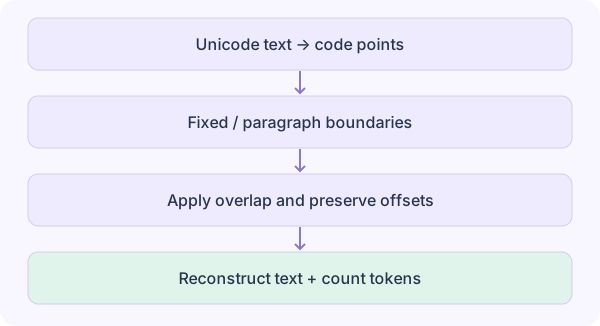
Chunk size and overlap are measured in Unicode code points, not tokens. Paragraph-aware mode prefers a newline boundary in the latter half of a chunk. Token counts are computed for every resulting chunk. Larger overlap duplicates text and may increase embedding work; this does not measure retrieval quality. Limit: 100,000 code points and 2,000 chunks.
Method references
Assumptions, implementation & acceptance
Chunk size and overlap are Unicode code points, not tokens or UTF-8 bytes. Reconstruct the input without duplicating overlaps; then separately count tokens.
Reviewed counting units, statistical assumptions and numerical examples. Provider accounting and actual GPU allocation still require external measurement.
Before running: predict a boundary case
Chunk size and overlap are Unicode code points, not tokens or UTF-8 bytes. Reconstruct the input without duplicating overlaps; then separately count tokens.
Hint: isolate the assumption
Keep the baseline input fixed, change one parameter or boundary, and compare both the numerical result and the claimed units. A passing example verifies this fixture only.
Minimal executable example
Save the example and linked modules in one folder. Use Node.js 22 or newer, then run node rag-chunker.mjs. npm install gpt-tokenizer@4.1.0
import {encode as rawEncode} from 'gpt-tokenizer/encoding/cl100k_base';
import {promptDiff,inspectDataset,chunkDocument,compareScores,estimateVRAM,samplingLab,speculativeLab} from './research-core.mjs';
const encode=s=>rawEncode(s,{disallowedSpecial:new Set()});
const text='你好🌍 abc '.repeat(8);
const result=chunkDocument(text,16,5,'fixed',encode);
const rebuilt=result.chunks.map(c=>Array.from(c.text).slice(c.overlapWithPrevious).join('')).join('');
console.log(rebuilt===text); // trueTest and transfer
Chunk size and overlap are Unicode code points, not tokens or UTF-8 bytes. Reconstruct the input without duplicating overlaps; then separately count tokens.
Record input, code version, expected result and observed result in the notebook below. Then construct a counterexample that violates the assumption above and explain why the original conclusion no longer follows.
Download complete kit (.tar.gz) · Complete reference kit and regression checksPredict, test and keep evidence
Before revealing an answer, predict one result. After the exercise, record the discrepancy and a transfer test. Saved locally across language editions.
Open notebook / export / clear →The mathematical review scope is recorded per lesson. It does not establish empirical paper reproduction; report suspected errors in your notes. Review scope