Customer-service agents: technology, customers and the investment landscape
A systems and business analysis of Sierra, Cresta, Decagon, Fin, PolyAI, Parloa and Ada: what their agents actually do, where defensibility comes from, and how to separate customer outcomes from attractive automation statistics.
Sources & version details
In this article
1. The business is completed work, not conversation
A customer says: “My order arrived damaged. Replace it before Friday; otherwise refund it.” A chatbot can quote the returns policy. A useful service agent must identify the customer, find the correct order, check evidence and eligibility, compare replacement stock and delivery promises, obtain consent, execute a permitted transaction, and communicate a verified result. If the inventory API times out, the agent must know whether a reservation exists before trying again. If no safe path exists, it must transfer both the conversation and the unfinished business state to a person.
This case is our running example. The core investment question is who can repeatedly deliver that whole outcome at an attractive cost while retaining the enterprise’s trust. A better language model helps, but the business also requires integrations, policy ownership, distribution, operations and a contract defining success. The enterprise buys an operating capability, not a benchmark score.
This survey distinguishes autonomous customer-facing agents, employee copilots and conversation analytics. They can coexist in one account, but their denominators and economic effects differ. CCaaS means contact-center-as-a-service: telephony, queues, routing and agent workspaces. CRM records customer relationships; an order or payment system remains authoritative for inventory or money. These distinctions explain why two vendors can both legitimately name the same customer.
The research cutoff is November 15, 2026, in America/Los_Angeles. Public product documentation, named customer stories and official financing or acquisition announcements were checked in separate passes, followed by a contradiction and metric review. Architectures below are our reference designs, not leaked vendor internals. Company performance is self-reported unless stated otherwise. Undisclosed contracts, margins, retention and deployment scope remain unknown. This is an analytical survey, not a market-share ranking or a recommendation to buy securities.
Three different customers, three different value propositions
The word customer hides three parties. The enterprise buys the software and carries the operational and financial risk. Its service employees operate exceptions and maintain policy. The end user needs a delivery, refund, account correction or other concrete result. The agent vendor must create enough value for all three while charging a sustainable price. Optimizing only the enterprise’s containment rate can make the other two worse off.
For the enterprise, value has four mechanisms: reducing avoidable handling, increasing capacity when demand spikes, preserving revenue through better service, and reducing preventable mistakes. These mechanisms are not interchangeable. Capacity released is not automatically payroll saved; retained revenue is not automatically incremental profit; a faster reply is not necessarily a faster refund. The buyer should name the mechanism before selecting a metric.
For the end user, the product is less effort and more certainty. They should not need to understand the merchant’s departments, repeat their story, guess the right policy phrase or check several channels for progress. A useful agent remembers the relevant state with permission, explains available choices and trade-offs, performs an authorized action, and gives a traceable confirmation. It also makes it easy to disagree, correct information or reach a person. The right to an effective remedy matters more than conversational charm.
For employees, the potential gain is removal of repetitive lookup, note-taking and system switching, together with better evidence when an exception reaches them. The counter-risk is concentration of the hardest, angriest cases, more opaque AI errors and intensified monitoring. Management must redesign staffing, authority, training and performance targets. The same average handle-time target may be unfair once the easy cases disappear.
Walk through the damaged-order case: where value is actually created
Before automation, the customer may wait in a queue, explain the damage, locate an order number, upload a photo and wait while an agent opens multiple systems. An email-only process may stretch these dependencies across several days. A well-run human team can already do this well; the comparison is with that actual process, not an artificially incompetent baseline.
With a bounded agent, identity and order lookup can happen in one session; evidence is collected once; replacement availability and delivery promises are checked against current systems. If Friday delivery is unavailable, the customer sees an honest refund or later-replacement choice rather than an invented promise. After consent, the execution layer records the operation and provides a receipt. If the outcome is unknown, the customer sees a pending state and a clear escalation owner, not a false success message.
The enterprise gains fewer avoidable touches and less work reopening failed cases. The user gains a shorter path to a reliable answer and does not need to coordinate internal departments. The employee gains a handoff containing the policy version, facts already checked, actions already attempted and exactly what remains unresolved. None of these benefits requires hiding the human-support option. They arise from removing coordination work while preserving accountability.
| Beneficiary | Practical value | Evidence to observe | Counter-risk |
|---|---|---|---|
| Enterprise buyer | Less rework, scalable capacity, protected margin | Completed-case cost; repeat contacts; cash versus capacity | Containment improves while unresolved cases disappear from view |
| End user | Less effort; a reliable result; choice and recourse | Active minutes; completion time; receipt; human access | Fast acknowledgment but no action; blocked cancellation |
| Service employee | Fewer lookups; useful context; authority over exceptions | System switching; exception difficulty; override rights | Only the hardest cases remain under unchanged targets |
| Agent supplier | Repeatable delivery, renewals and sustainable contribution | Implementation reuse; cohort retention; support-adjusted margin | Revenue grows with bespoke labor and expensive failures |
2. A market map organized by control points
Four entry points, increasingly convergent products
Sierra and Decagon enter as a new customer-facing execution layer. They can sit above existing helpdesks and systems of record. Cresta’s historical entry is conversation intelligence and assistance for human contact-center workers, expanding into autonomous execution. PolyAI and Parloa put particular emphasis on enterprise dialogue and voice operations. Fin and Ada connect support knowledge, workflow authoring and automation. These are entry-point distinctions, not permanent feature boundaries: their current portfolios increasingly overlap. [S1] [S5] [S8] [S11] [S16] [S18] [S20]
Incumbents start closer to an installed budget. Salesforce controls CRM workflows; Zendesk controls support tickets and agent workspaces; NiCE and Genesys control substantial contact-center operations. Amazon and Google offer infrastructure plus higher-level service-agent products. A specialist may win on deployment quality, domain behavior or neutrality; a platform can counter with procurement simplicity, integration and bundled economics. “Model provider” and “agent competitor” are therefore not mutually exclusive roles. [S24] [S26] [S28] [S30] [S31]
What an actual moat must survive
An investor should ask which asset remains valuable if a foundation model becomes twice as good and half as expensive. A prompt library is easier to replicate than reliable order-system actions, a customer-approved policy corpus, regression cases from difficult production incidents, a trusted deployment team or distribution through an existing contract. Yet integration is not automatically a moat: if it requires months of unreusable services for each customer, it may be a cost center. The distinction is repeatable deployment knowledge versus permanent custom labor.
| Company | Technical control point | Customer evidence / scope | Question to resolve before buying |
|---|---|---|---|
| Sierra | Model orchestration; customer journeys | Airtable resolution; Chime/CarMax/Rocket logos [S3] [S4] | Implementation reuse, authority boundaries, durable resolution |
| Cresta | Conversation intelligence → assist → autonomy | United: assisted handle-time reduction; Cox [S7] [S32] | Separate autonomous revenue and results from copilot effects |
| Decagon | AOP authoring; long-horizon Missions | Chime chat/voice, vendor case study [S10] | Durable state, cancellation, customer/channel attribution |
| Fin / Salesforce | Retrieval engine + CRM distribution | Official acquisition close; billing rules [S13] [S15] | Billable outcome versus true resolution; integration maturity |
| PolyAI | Enterprise dialogue and voice operations | Marriott / Caesars / PG&E in announcement [S17] | Real channel latency, transfers and integration scope |
| Parloa | Agent fleet authoring and operations | Allianz / Booking.com / IKEA [S40] | Regional policy changes, approvals and rollback |
| Ada | Playbooks + API/MCP/code execution | Product documentation, not comparable outcome data [S20] [S21] | Sandbox limits, action authorization and release ownership |
3. Reference architecture: from customer intent to an accountable outcome
The execution plane
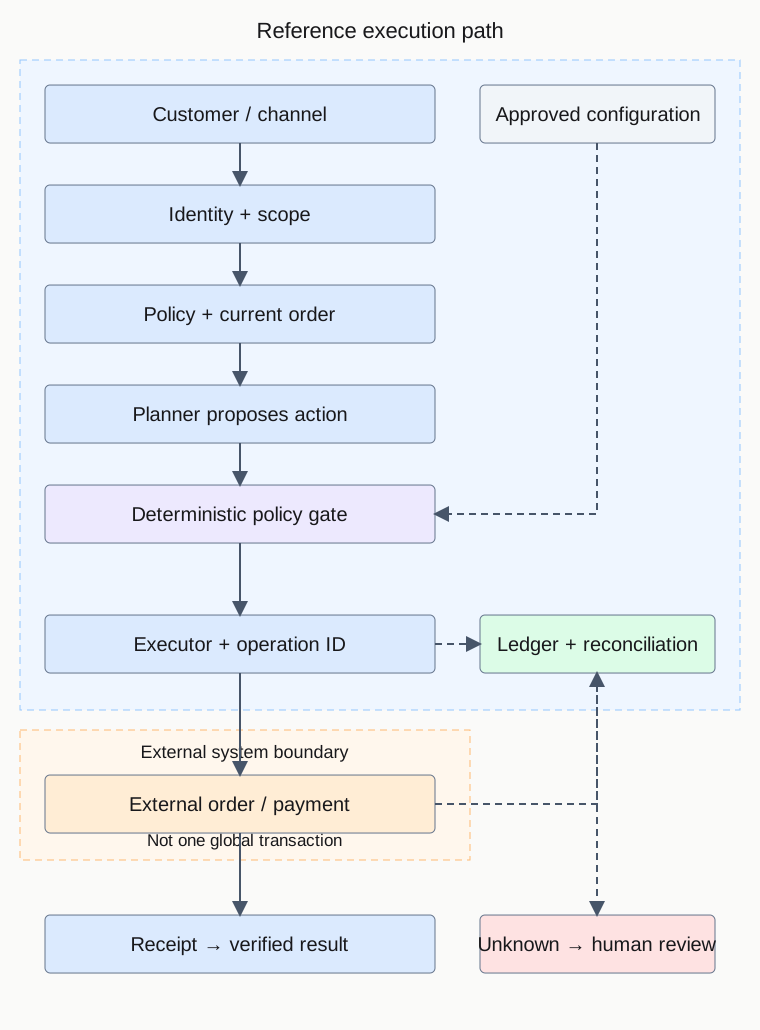
The channel adapter receives text or streaming audio and establishes session identity. Customer authentication then yields narrowly scoped capabilities; caller ID or a convincing voice is not authorization. A context service combines current order state, customer entitlements and versioned policy evidence. Retrieval must filter by tenant, product, market and effective date before presenting relevant material. Finding a refund policy does not authorize a refund.
The planner proposes the next action. A deterministic gate checks the tool schema, customer/order relationship, amount, consent and policy version. The executor records a stable operation ID before invoking an order, payment or scheduling API. A durable ledger stores submitted, confirmed and unknown outcomes. A timeout after submission enters reconciliation, not automatic failure. The answer to the customer is generated from confirmed receipts and the current case state. A human handoff carries those receipts, pending actions and the reason for escalation, rather than just a transcript.
The control plane
Business owners maintain policies; engineers own connectors and permission enforcement; operations teams own queues and recovery; security owns access boundaries. A release binds model route, prompt, workflow, tools, knowledge version and policy version. Test results and approval belong to that release. Changes to conversational wording and changes to refund authority need different risk treatment. Rollback stops future use of a defective version; it does not reverse already completed payments.
The reference diagram deliberately separates a business system’s transaction from the agent’s local state. An outbox can make local intent plus dispatch recording atomic, but cannot make a third-party refund part of that transaction. External documents, tool responses and customer messages are data, not permission to expand authority. MCP standardizes a tool interface; it does not supply business authorization or exactly-once execution. These are system-design requirements, not claims that every named vendor exposes the same implementation.
4. Voice changes the engineering problem
Latency is a pipeline, not a model number
A voice turn includes endpoint detection, transcription or audio understanding, policy/context retrieval, reasoning, tools, speech generation and transport. A low time-to-first-audio does not establish low time-to-completed-refund. Some components overlap under streaming; serial component times cannot simply be added to estimate every real deployment. Measure first audible response, interruption handling and confirmed business completion separately.
As an explicitly synthetic serial budget, 180 ms endpointing + 120 ms recognition + 250 ms reasoning + 350 ms tool work + 100 ms speech startup + 80 ms transport gives 1,080 ms. Saying “I’m checking that” earlier can improve perceived responsiveness, but must not imply the replacement was booked. A fast acknowledgement is not a committed action. Background noise, accents, spelled identifiers, multilingual switching and interruptions need dedicated handling.
Reliability compounds across stages
For eight essential steps with independent success probability 0.98 each, the probability that all succeed is about 0.851. Independence is only a teaching assumption: an incorrect identity can corrupt several downstream steps together. Supervisors also have correlated errors; two model checks do not automatically multiply into near-perfect reliability. Deterministic checks are appropriate for amounts, permissions and required fields; model judgment helps with intent, ambiguity and conversational expression.
Speech-native models may reduce cascade loss and improve turn-taking, while a cascade can expose clearer transcription and component-level debugging. Neither removes business-state correctness. PolyAI’s public site describes both audio-native and text/cascade model families; its latency numbers are vendor-defined measurements and not a controlled comparison against Sierra, Cresta or Parloa. [S16]
5. Sierra: a customer-facing orchestration and relationship layer
What is publicly described
Sierra’s December 2025 architecture describes 15+ frontier, open-weight and proprietary models assigned to separate tasks, supervised orchestration, and provider failover. That is a portfolio used by the platform, not evidence that every conversation invokes fifteen models. Its current offering adds agent-building and optimization with Ghostwriter and long-horizon work through Horizon. [S1] [S2]
How the advantage could work
In the damaged-order case, classification and routine lookup can follow a low-latency route while ambiguous policy interpretation uses a different capability. Separating tasks lets the platform change one model without intentionally changing transaction authority. This is a plausible engineering advantage when supported by task-specific regression tests. Merely adding models creates coordination cost, extra latency and more failure modes; the valuable asset is the routing, evaluation and release discipline around them.
Sierra’s partnership model can absorb work a customer cannot easily staff: journey design, integrations, policy translation and ongoing improvement. That helps an executive sponsor buy an outcome rather than assemble a platform team. The investment tension is whether deployment work becomes reusable software or remains forward-deployed labor. Ask for cohort-level implementation hours and support load, not just launch anecdotes.
Customers, economics and what remains unproven
The Airtable case reports an 80% AI resolution rate and describes a unified support entry point; it is a vendor-hosted customer account, not a randomized comparison. Other named relationships include Chime and CarMax, but a logo does not identify scope or exclusivity. Sierra describes outcome-based pricing; the sources reviewed do not establish a universal per-outcome tariff. [S3] [S4]
The longer-term thesis is that customer context and multi-system action increase switching costs. The counterargument is that the enterprise owns those records and may require portable exports, independent workflow definitions and alternative execution vendors. November’s Anon acquisition announcement concerns browser interaction and authentication expertise, extending reach to systems without APIs. It does not prove all those capabilities are already integrated into every Sierra deployment. [S29]
6. Cresta: learning from the contact center, then automating it
A different starting position
Cresta’s platform joins conversation intelligence, human assistance and autonomous agents. Its AI Agent documentation describes deterministic code alongside reasoning, tool access, simulations and an operations center. On October 29, 2026 it opened developer self-service using Conductor, a CLI and customer-controlled repositories and release workflows. [S5] [S6]
The distinction matters. In the order scenario, Cresta can first observe which situations force human transfers, identify missing policy or tool coverage, assist a human handling the exception, and then automate an approved subset. The same organization can buy efficiency today and deeper automation later. This is an attractive expansion path if the data actually improves workflows rather than generating dashboards nobody acts upon.
The potential technical moat
Production conversations contain rare exceptions, successful recovery strategies and the difference between policy on paper and work in practice. Converting them into approved requirements and representative regression cases can lower deployment risk. But top-performing human behavior is not automatically lawful or correct. Historical concessions, regional policy differences and sensitive customer data need filtering; customer data rights constrain any cross-account training advantage.
Cresta’s developer access also changes buyer dynamics: an internal engineering team can retain its repository and CI/CD habits while using a managed runtime. Ask which assets are exportable, who can approve a production release, and how a rollback affects active calls. A Git integration is valuable only if the tested artifact is the deployed artifact, including model, knowledge and tool configuration.
Read its customer proof carefully
United Airlines’ published case emphasizes insights and Agentic Assist and reports a 15% improvement in average handle time. Cox’s case focuses on assisted sales/retention workflows. These support a human-productivity and operational-learning thesis; they do not measure the autonomous resolution rate of every Cresta customer. Cresta’s history page reports reaching $100M ARR in 2026, but does not break that amount into autonomous agents versus other products. [S7] [S32] [S33]
The investment question is whether the installed assistance/analytics base accelerates autonomous-agent adoption without creating costly product complexity. Demand the attach rate, realized production volume and gross margin of each product family. Neither total ARR nor a new AI Agent logo answers those questions.
7. Decagon: making operating procedures executable
AOPs are the authoring abstraction
Decagon describes Agent Operating Procedures, or AOPs, as natural-language workflows that business teams can edit while engineers retain control of integrations and guardrails. Duet supports iterative analysis and changes. Its November 12, 2026 Missions announcement extends the concept to cases spanning people, systems and days. [S8] [S9]
For our retailer, an AOP can separate evidence collection, eligibility, replacement preference and refund fallback. The business operator can change how the agent asks about damage; a refund limit remains a controlled backend rule. This separation is more useful than forcing every policy change into a code sprint, but natural-language authoring is not a proof that execution is deterministic. Ask to see the runtime trace when a customer changes intent halfway through.
Advantages and failure boundaries
A coherent authoring model can make continuous improvement faster: observe a failure, identify the wrong step, propose a change, run a frozen regression set and approve a version. It becomes a moat if nontechnical operators can maintain complex workflows without bypassing security or repeatedly needing vendor engineers. It becomes a liability if ambiguity accumulates in prose and small changes alter unrelated paths.
Long-running Missions create a larger revenue opportunity but a harder engineering problem. A customer may withdraw consent, a tool token can expire, stock can change, and a third party may never reply. The system needs durable business state, timers, stop conditions and an accountable human queue. “Memory” is not an adequate substitute for those mechanisms; the due-diligence question is how each is implemented and exposed.
Customer evidence
Decagon’s Chime case reports roughly 70% chat/voice resolution for the supported use cases, but also states that Chime uses multiple technology partners. Its support-cost reduction references Chime’s 2025 S-1; that enterprise-level outcome should not be attributed solely to Decagon. Ask for workload, date range, exclusions and recontact rates before transferring this result to another bank or retailer. [S10]
8. Fin and Salesforce: specialized service AI meets the CRM distribution channel
Fin’s documented engine refines a query, retrieves relevant knowledge, reranks, generates and validates an answer. Its current model suite includes specialized retrieval/reranking and Apex generation. This is an applied-model and product-iteration route, not simply a generic LLM with a help-center prompt. Public “best” performance claims remain vendor claims unless the same task mix and evaluation protocol are available. [S11]
For a documentation-heavy software company, support content, an inbox and observable conversation outcomes can make this a practical starting point. Moving from answers to actions still requires permissions, current system state and business receipts. Proprietary support models could improve cost and consistency on common tasks, while unusual workflows or language/domain shifts may still require escalation. The moat test is repeatable production lift after controlling for easier tickets, not the word “proprietary.”
Ownership is important. Salesforce announced the approximately $3.6B Fin transaction on June 15, 2026 and announced completion on September 10. The two products should therefore not be treated as independent companies in an ownership map. However, common ownership does not establish identical runtimes, unified pricing or fully integrated data policies. [S12] [S13]
Salesforce’s architectural documentation describes Agent Script compiled into an Agent Graph executed by Atlas, with deterministic conditions separated from LLM nodes. That is a useful pattern for CRM-centric enterprises whose data, flows and permissions are already embedded in Salesforce. Its platform breadth can reduce procurement friction but also increases configuration, data and license dependencies. Fin can offer a faster deployment path while Agentforce offers deeper customization; verify the actual product boundary in the contract. [S14]
Fin’s published billing definition is especially important: a paid outcome can include an assumed resolution or a configured Procedure ending in handoff. These are not all independently verified autonomous resolutions. Its listed chat/email resolution or procedure-handoff price is $0.99 per outcome under the documented conditions; voice and specialized arrangements are separate. Count contractual billable events and real customer success in two different columns. [S15]
9. PolyAI and Parloa: voice quality and fleet operation
PolyAI
PolyAI publicly emphasizes its dialogue models, voice interactions and enterprise integrations. Its December 15, 2025 financing announcement reports an $86M Series D and names customers including Marriott, Caesars and PG&E. These are disclosed relationships, not proof that the vendor owns every customer channel or that each deployment has the same automation rate. [S16] [S17]
The technical thesis is vertical optimization: turn-taking, noisy audio, latency and dialogue behavior must work together with business tools. A restaurant booking that correctly handles interruption and confirms the actual reservation is more valuable than a voice demo that merely sounds human. The diligence burden is correspondingly specific: test real telephony codecs, authentication failures, names and dates, rather than a studio microphone. Specialized model investment can improve unit economics at scale, but adds training, serving and model-maintenance costs.
Parloa
Parloa’s current builder describes shared blueprints, subtask agents and deterministic routing. Its Performance Lab combines historical and synthetic scenarios, with human review before generated tests leave draft. Its January 15, 2026 announcement reports $350M at a $3B valuation, led by General Catalyst. Publicly named customers include Allianz, Booking.com and IKEA. [S18] [S19] [S34] [S40]
The investment thesis is management of a fleet, not one impressive bot. Reusing a blueprint across brands or markets can reduce rollout cost while local settings preserve differences. The risk is correlated failure: a central update can break many deployments together. Ask about canaries, per-market release pins, region isolation and emergency human routing. Deterministic routing limits one source of variance; it does not ensure every model answer or external transaction is correct.
These two companies deserve comparison with voice-heavy deployment specialists and CCaaS incumbents, not only text-helpdesk bots. Evaluate language/accent coverage, channel availability, observability and failover in the customer’s actual contact mix. A published sub-300-ms model response and another company’s case-resolution percentage measure different things and should not share a league table.
10. Ada and the incumbent/platform alternatives
Ada’s current documentation makes workflow structure tangible: Playbook steps collect values, store variables, branch and run tools. Its Computer product distinguishes API, MCP and sandboxed code tools and recommends keeping write tools behind controlled Playbook steps. This makes it a useful comparison for teams that want business-operable authoring with explicit action points. A recommendation in documentation is not proof that every customer configured the boundary correctly. [S20] [S21]
For Ada, ask whether new and legacy workflow types have different semantics, whether policy changes are reviewable, and how credentials are scoped. Its documented migration from older workflow types also illustrates a general risk: buying a platform entails ongoing semantic migration, not just paying for inference. Current public investor information lists more than $200M raised; it does not establish current valuation or standalone autonomous-agent ARR. [S22]
Zendesk completed its Forethought acquisition on March 26, 2026; a June product notice describes purchasable capabilities both for Zendesk and other helpdesks. NiCE completed Cognigy’s acquisition on September 8, 2025 and described both CXone and standalone availability. The strategic advantage is access to existing service operations and procurement. It is not proof of an instant unified architecture. [S23] [S24] [S25]
Genesys, Amazon Connect and Google’s CX offering belong in a serious shortlist when a buyer already uses their operational stack. Their published materials describe combinations of orchestration, knowledge, human assistance and customer-facing actions. A company that already controls call routing can make escalation and operational ownership easier; the buyer still needs to compare feature availability, region support, integration effort and total cost. Building on infrastructure can offer control, but transfers more runtime and evaluation work to the customer. [S26] [S27] [S28]
This is a selective map. Smaller voice platforms, vertical specialists, BPO-led offerings and vendors such as Gorgias, Freshworks and ServiceNow can matter for specific segments. They are not ranked here without comparable current evidence. Enterprise voice replacement, an ecommerce helpdesk plugin and a developer voice API solve different procurement problems.
11. Customer relationships: what logos and case studies cannot tell you
Map the relationship, not just the name
For each reference customer, record product, channel, business unit, geography, rollout stage, date, volume, incumbent system and commercial owner. “Used by an airline” can mean a pilot for one intent, analytics across all calls, an employee assistant or a production autonomous agent. These carry radically different revenue potential and implementation risk. A strategic partnership, a named customer and a paying scaled deployment should have separate labels.
Chime illustrates why this matters: public Sierra and Decagon materials both name it. The evidence does not establish that one replaced the other, that deployments are simultaneous in every channel, or that either is exclusive. Cresta’s United case explicitly emphasizes assistance and insights. Sierra’s Airtable case reports resolution. Those are useful facts with different scopes, not a common benchmark. [S4] [S10] [S7] [S3]
Who buys and who can stop the deal
The VP of customer service owns queue performance and customer experience; the COO or CFO cares about cost and operating leverage. CIO/integration teams own system access, while security and privacy teams can block launch. Procurement sets commercial terms; frontline managers and agents determine whether handoffs actually work. A successful vendor needs an executive sponsor and an operating owner who can change policies, not merely a proof-of-concept champion.
Sales channels can include direct enterprise selling, system integrators, CCaaS/CRM partnerships and BPO relationships. A partner can lower customer acquisition cost and accelerate integrations, but may control the renewal or prefer a competing bundle. BPO incentives can conflict with automation that reduces billable labor; an outcome contract can realign them, but only if risk and savings are clearly shared. Specific partner exclusivity or revenue share is not assumed where it is undisclosed.
How each vendor’s technical entry point can create customer value
The following links are analytical hypotheses derived from the public product descriptions, not independently measured ROI. Sierra’s orchestration and journey layer is valuable when the expensive problem is coordinating several systems and preserving a coherent customer relationship. The buyer should see fewer fragmented interactions; the user should see the same case continue across channels. If backend authority or policy is missing, fluent orchestration alone does not deliver that benefit.
Cresta’s assist-and-intelligence entry can create value even when full autonomy is unsuitable: faster access to relevant evidence, more consistent guidance, and learning from the reasons humans intervene. This can help a complex regulated contact center without making every transaction autonomous. Its autonomous-agent value should be evaluated separately; faster human handling does not prove the agent can safely execute the same work alone.
Decagon’s AOP approach can reduce the gap between a business policy change and a controlled runtime change. Missions potentially reduce the user’s burden of chasing a case that spans days. The corresponding obligation is ownership of unfinished work: who notices a missed update, who changes the plan, and who remains accountable after the original conversation ends?
Fin’s retrieval and support-workflow entry can reduce the work of finding a correct answer in a large knowledge base; Salesforce’s distribution can reduce procurement and integration friction. PolyAI and Parloa address the value of a usable voice channel and repeatable enterprise operation. Ada’s structured playbooks and tool connections can help operational teams maintain explicit processes. In every case, the benefit must be tested on the buyer’s intents, languages and actual systems. A product’s feature is a means; a verified customer outcome is the value.
Why relationships deepen—or fail to deepen
A durable commercial relationship forms when the supplier becomes a dependable partner in operating the service: it helps maintain policies, responds to failures, makes changes safely and supplies credible evidence of results. That can support expansion from one workflow to more channels or business units. It is a hypothesis about repeatable value, not proof that a named customer has bought every product.
Relationships weaken when reported savings cannot be reconciled with invoices, customers cannot reach a human, changes require expensive vendor services, or liability is unclear. A technically impressive agent can lose the account if the customer cannot govern it. Conversely, a less novel architecture can win through implementation reliability, clear responsibility and integration with the buyer’s existing operating model.
12. Deployment is a joint operating model
A realistic rollout begins with an intent inventory and ownership map. Collect versioned policies and permission-safe historical cases, identify the systems that can establish truth, and assign a person to every exception queue. Start with a bounded workflow such as shipment lookup before introducing irreversible changes. The agent’s scope should follow reliable backend capabilities, not the most impressive demo.
The vendor may supply the runtime and implementation experts; the customer must supply valid policy, data access, approvals and operational staffing. Agree who maintains connectors when the order API changes, who handles overnight incidents, who investigates a disputed action and who can pause automation. A “fully managed” contract does not eliminate the customer’s obligation to define the business rule.
Expansion can go from one intent to more intents, from chat to voice, from one market to more regions, then into sales or retention. Each expansion changes risk: outbound contact adds consent and timing constraints; a retention offer introduces eligibility and fairness questions; cross-channel memory introduces deletion and access obligations. Expansion revenue is higher quality when driven by repeatable safe adoption, not one-off services or discounts.
For exit planning, negotiate exports of knowledge, workflows, test cases, action receipts and conversation metadata, plus deletion and migration terms. A customer-owned CRM does not automatically make agent configuration portable. Dual-running a successor also creates duplicate-action risk, so the migration needs a single authority for writes and a clear cutover boundary.
13. Unit economics: compare cost per verified outcome
Define the denominator first
Containment means a conversation did not transfer to a human. Deflection often describes avoiding assisted contact, with vendor-specific definitions. Resolution should mean the intended problem was actually solved. Recontact is a later return for the same unresolved issue. A customer who gives up can be “contained” without being helped. Use a business-specific recontact window and independently sample the underlying outcome.
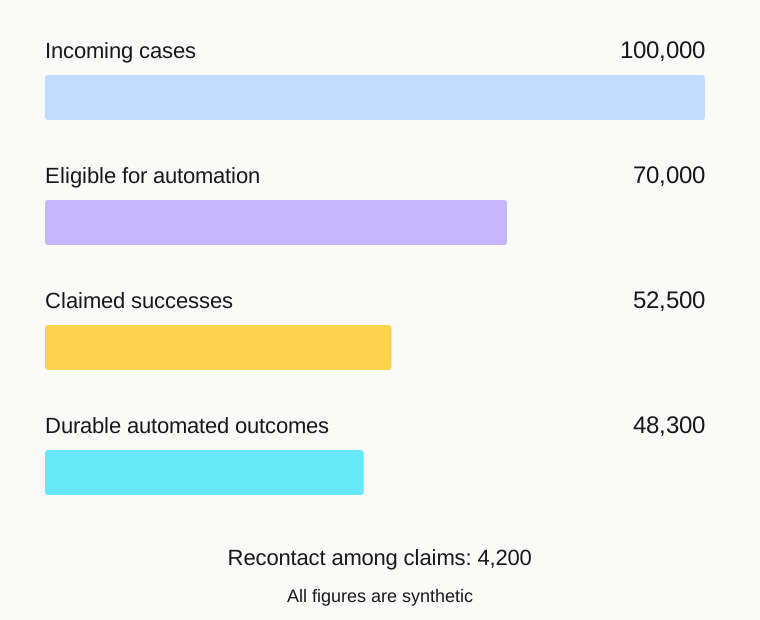
Let N be monthly incoming cases; e the fraction eligible for automation; s the claimed success fraction among eligible cases; r the same-issue recontact fraction among claimed successes. Our simplified durable-automation fraction is e·s·(1−r). This excludes other error categories and is not a universal vendor metric. Let b be dollars billed per claimed success, c the extra AI/channel cost per incoming case, h the human cost per remaining case, F fixed monthly operations/integration cost, and L expected error loss in dollars per month. The total cost equation below uses N·e·s billable events, not N times the durable-resolution fraction.
A complete synthetic calculation
For N=100,000, e=0.70, s=0.75 and r=0.08, there are 52,500 claimed successes but only 48,300 durable automated cases. With b=$1.20, c=$0.12, h=$4, F=$25,000 and L=$5,000, modeled monthly cost is $311,800. Against a hypothetical all-human baseline of $6 per incoming case, savings are $288,200. These prices are invented scenario inputs, not quotations for any company. If an actual contract bundles inference into outcome pricing, avoid counting it twice.
Reducing s to 0.60 and increasing r to 0.15 gives 35,700 durable automated cases and $349,600 cost. The model still shows savings, but the residual human workload has increased. Human cases often become harder after routine cases are removed, so assuming constant h can overstate savings. Fixed headcount, minimum commitments, implementation delays, telephony, taxes and seasonal peaks can alter cash savings materially.
Investor economics are different from buyer savings
Vendor gross profit is revenue minus model/speech/telephony costs, hosting and directly attributable delivery/support costs under its accounting policy. Customer ROI is not vendor gross margin. FDE payroll may sit in cost of revenue or operating expenses; comparisons require consistent classification. Request gross retention and net revenue retention by cohort, consumption versus committed ARR, services mix, customer concentration, ramp time and contribution margin after implementation. Private firms generally do not publish all of these, so growth alone cannot establish profitability.
Separate capacity value, cash value and revenue value
Consider a separate synthetic service-effort example: 10,000 cases per month previously required eight minutes of active staff work each, and now require two minutes on average including exceptions. The difference is 60,000 minutes, or 1,000 hours of released capacity. At an illustrative $30 per hour, that is $30,000 of equivalent labor capacity—not a guaranteed $30,000 reduction in cash expenditure. Fixed employees, minimum BPO commitments and redeployment determine how much becomes cash savings. This example is independent of the earlier 100,000-case cost model; do not add it to that model’s savings.
Revenue value needs a different counterfactual. Better service may reduce cancellations, improve renewals or recover an abandoned purchase, but a conversation followed by a sale does not prove the agent caused the sale. Count incremental contribution margin after discounts, returns, fulfillment and service costs, not total order value. An agent that prevents cancellation by frustrating the customer can improve a short-term retention statistic while harming trust and future revenue.
The user’s time also has value, even when it does not appear on the buyer’s ledger. Report active effort separately from elapsed time to business completion: an instant acknowledgment followed by a week of uncertainty is not an instant resolution. A financial remedy should be judged by the actual account correction or payment status, not merely by the message saying it was requested. Accessibility, language quality and the ability to contest a decision are part of service quality rather than optional polish.
14. Funding and acquisitions: distinguish capital, revenue and control
Sierra announced a $950M raise on May 4, 2026 at a valuation above $15B, led by Tiger Global and GV; on October 30 it reported more than $400M ARR. These are company statements, not audited recognized revenue. Cresta’s official Series D release states $125M led by WiL and QIA, and its history dates that round to 2024. Its current history page reports $100M ARR in 2026 without a product split. [S35] [S36] [S37] [S33]
Decagon announced $250M at $4.5B on January 27, 2026, led by Coatue and Index. Parloa announced $350M at $3B on January 15, 2026. PolyAI announced $86M on December 15, 2025. Financing sizes and valuations reflect different dates, preferences and investor expectations; they are not operating-performance rankings. Current comparable ARR, gross margins and retention are not established for all companies by these sources. [S38] [S19] [S17]
The transaction table separates agreement dates from completion dates. Fin’s approximate $3.6B agreement value and Cognigy’s approximately $955M announced transaction value are not interchangeable with startup funding valuations. The reviewed Forethought completion notice and Anon announcement do not disclose transaction prices. Do not fill those gaps with estimates presented as facts. [S12] [S13] [S23] [S25] [S29] [S39]
Our interpretation is that acquirers are buying different missing control points: service-agent capability and distribution for Fin/Salesforce; agent automation for Zendesk/Forethought and NiCE/Cognigy; authenticated browser execution for Sierra/Anon. An acquisition may strengthen distribution while increasing integration work and conflicts with existing partners. Common ownership, product availability and completed technical integration are three separate milestones.
| Funding / transaction | Event date | Publicly announced terms | Evidence / limits |
|---|---|---|---|
| Sierra | 2026-05-04 | $950M · >$15B | [S35] |
| Cresta | 2024 | $125M · Series D | [S37] |
| Decagon | 2026-01-27 | $250M · $4.5B | [S38] |
| PolyAI | 2025-12-15 | $86M · Series D | [S17] |
| Parloa | 2026-01-15 | $350M · $3B | [S19] |
| Ada | 2026-11-15* | >$200M | [S22] |
| Salesforce → Fin | 2026-06-15 → 2026-09-10 | ~$3.6B | [S12] [S13] |
| Zendesk → Forethought | 2026-03-26 | — | [S23] |
| NiCE → Cognigy | 2025-07-28 → 2025-09-08 | ~$955M | [S39] [S25] |
| Sierra → Anon | 2026-11-05 | — | [S29] |
USD. For financing, the second amount is a reported valuation only when present. Ada is cumulative funding checked on the marked date, not a new round. Acquisition arrows separate agreement and completion dates where both are shown. A dash means consideration not disclosed in the reviewed sources. Capital raised is not revenue; valuations are not comparable transaction multiples.
15. The competitive moat: a testable investment thesis
Five assets that could compound
First, workflow depth: the agent can finish difficult work against real systems. Second, operational learning: new incidents become reviewed policies, tests and recoverable failure paths. Third, distribution: a trusted customer or platform channel lowers selling friction. Fourth, domain economics: specialized inference and efficient serving lower delivered cost without shifting risk to users. Fifth, customer organizational adoption: managers can operate and improve the system themselves.
Each has a falsifier. Workflow depth is weak if every new tool requires bespoke vendor work. A data flywheel is weak if training rights are absent, historical labels are wrong or feedback never changes behavior. Distribution is weak if a platform can revoke access or bundle a good-enough competitor. Model specialization is weak if improvements disappear on independent tasks. Organizational adoption is weak if only the vendor can diagnose failures. This is an analytical framework, not a claim that one company has already won all five.
Risks an investor should price
A rapidly improving base model can compress application differentiation, but does not automatically erase integrations and trust. Outcome pricing can align incentives, yet also create disputes about silent abandonment, repeated contact and paid handoff. High services intensity can accelerate early revenue while lowering scalability. Long-horizon work can expand wallet share while increasing liability and working-state complexity. Customer concentration makes a handful of renewals disproportionately important.
A useful diligence conversation asks for a renewal cohort, not a logo slide; a release-to-production trace, not a demo; and a bottom-up cost bridge, not an unqualified “AI margin.” Ask what happens if the incumbent CRM includes a comparable agent in the existing contract. The specialist must demonstrate enough incremental quality, speed or flexibility to justify another vendor and another operational dependency.
16. What may happen next — scenarios, not predictions
In a platform-consolidation scenario, existing CRM and CCaaS contracts absorb many standard workflows. Specialists retain complex domains or become acquisition targets. Watch the actual attach rate, displacement and renewal concessions; press-release partnerships alone do not show which side captures margin.
In a specialist-execution scenario, enterprises retain their systems of record while buying a neutral agent layer. The winner is the vendor that repeatedly integrates unfamiliar systems, makes exceptions recoverable and transfers operating knowledge to the customer. Watch implementation hours per deployment, scope expansion and the fraction of changes customers can safely ship themselves.
In a personal-agent scenario, an end user’s agent negotiates with the company’s agent. Identity delegation, consent, rate limits, fraud controls and machine-readable policies become important. This may weaken branded chat surfaces but increase demand for trusted execution APIs. Treat it as a developing distribution channel, not evidence that human support is already obsolete.
The frontier is therefore controlled long-horizon execution: work continues across sessions, permissions expire safely, updates are reviewable and success is evidenced by business systems. The open problems are outcome attribution, correlated model errors, rare costly mistakes, cross-channel identity, memory deletion, multilingual equity and benchmark leakage. No public evidence reviewed supports declaring any vendor universally best across all of them.
When automation creates shared value—and when it merely shifts the burden
The strongest opportunity is a workflow with repeated coordination, trustworthy backend interfaces and clear permissions, where users benefit from faster completion and humans can own exceptions. It is weaker when policies are contradictory, records are unreliable or most cases require negotiation that the organization has not delegated. Buying an agent cannot repair an undefined refund policy or an unreachable escalation team by itself.
The ideal commercial alignment rewards a durable, authorized result and treats unresolved cases transparently. A bad alignment rewards silence: no transfer, no reply or an expired conversation is counted as success. The provider, enterprise and end user then have conflicting incentives. Outcome pricing is useful only when the outcome definition, observation window, dispute rights and exclusions genuinely reflect customer value.
17. Practice and validation: run a defensible procurement exercise
Freeze a representative set of intents, languages, difficult customers and backend failures before a vendor tunes the agent. Include denied refunds, stale policy, duplicate submission, malicious text inside retrieved content, a tool timeout after a successful write, withdrawal of consent and unavailable human staffing. Use synthetic or authorized de-identified data. A test environment should not send real refunds or contact real customers.
Compare the same permitted tools, policies, model budgets and escalation options. Report results separately by intent and risk class. Use business receipts and independently reviewed samples to establish completion; use LLM judges only as one signal. Report false-success rates, recontacts, handoff quality, P50/P95 latency and cost per verified outcome. Zero observed harmful actions in 100 trials is not proof of zero risk: under an independent Bernoulli approximation, the rule-of-three upper bound is about 3%, and correlated cases weaken the inference further.
Run the downloadable standard-library Python model below. It reproduces the two synthetic cost scenarios, rejects invalid rates and checks that paid claims and durable outcomes differ. It is deterministic, requires Python 3.11+, uses no network or API key, and has no random seed because it draws no random numbers. This validates arithmetic, not vendor quality or production readiness. Replace assumptions with an independently measured pilot and the actual contract before making a buying decision.
A practical acceptance report should state the workload, policy/model/tool versions, permissions, failure handling, cost definitions, exclusions and rollout owner. Begin with shadow evaluation, then a capped production canary with a kill switch and staffed human fallback. Do not optimize containment by making human escalation hard to reach. Only expand when the business outcome and customer experience both improve.
A value scorecard that cannot be passed by trapping the user
Before a pilot, agree on three groups of evidence. Enterprise: verified cost per completed case, rework, exception load and cash savings versus capacity released. End user: active effort, elapsed completion time, repeated contact, successful access to a person and whether the promised action occurred. Employee: exception complexity, context quality, workload, override authority and avoidable system switching. Slice results by intent, language, accessibility needs and customer segment without collecting unnecessary sensitive data.
Make quality and authorization constraints gates, not weights that cheaper operation can cancel out. A lower cost cannot compensate for an unauthorized refund or systematic refusal to provide an available remedy. Compare equivalent cohorts over an adequate recontact window, include integration and maintenance, and review dissatisfied or abandoned sessions. A pilot passes when the business result improves without moving hidden work or risk onto users or employees—not merely when the bot handles more conversations.
Local economic model
customer-service-economics.pypython3 customer-service-economics.pyExpected output: base cost $311,800 and savings $288,200; stress cost $349,600 and savings $250,400. These are deterministic synthetic calculations, not real-world savings.
Python 3.11+
"""Synthetic procurement model. Python 3.11+, standard library, no network.
No vendor quote or measured performance. Deterministic: no random seed.
Money and probabilities use Decimal. A billable claim is not durable resolution.
"""
from decimal import Decimal as D


def economics(n=100000, eligible='0.70', solved='0.75', repeat='0.08',
              bill='1.20', variable='0.12', human='4', fixed='25000',
              loss='5000', baseline='6'):
    if not isinstance(n, int) or isinstance(n, bool) or n < 0:
        raise ValueError('n must be a non-negative integer')
    e, s, r = map(D, (eligible, solved, repeat))
    b, c, h, f, risk, h0 = map(D, (bill, variable, human, fixed, loss, baseline))
    if any(not x.is_finite() or not 0 <= x <= 1 for x in (e, s, r)):
        raise ValueError('probabilities must be finite and in [0,1]')
    if any(not x.is_finite() or x < 0 for x in (b, c, h, f, risk, h0)):
        raise ValueError('costs must be finite and non-negative')
    claims = D(n) * e * s
    durable = claims * (1-r)
    # Residual human work includes ineligible, unsolved and repeat contacts.
    # This simplified model counts one human intervention per residual case.
    total = claims*b + D(n)*c + (D(n)-durable)*h + f + risk
    return {'claims': claims, 'durable': durable, 'cost': total,
            'savings': D(n)*h0-total}


def check():
    first = economics()
    assert first == dict(claims=D(52500), durable=D(48300),
                         cost=D(311800), savings=D(288200))
    second = economics(solved='0.60', repeat='0.15')
    assert second == dict(claims=D(42000), durable=D(35700),
                          cost=D(349600), savings=D(250400))
    assert economics(eligible='0')['durable'] == 0
    assert economics(repeat='1')['durable'] == 0
    assert economics(n=0)['cost'] == D(30000)  # fixed costs still exist
    assert first['claims'] > first['durable']
    for args in ({'eligible':'1.1'}, {'repeat':'-0.1'}, {'bill':'-1'},
                 {'fixed':'NaN'}, {'n':-1}, {'n':True}):
        try:
            economics(**args)
        except ValueError:
            pass
        else:
            raise AssertionError(args)
    for label, case in [('base',first),('stress',second)]:
        print(label, ', '.join(f'{k}={v:,.0f}' for k,v in case.items()))
    print('PASS: 2 scenarios; boundary and invalid-input checks')


if __name__ == '__main__':
    check()
18. Original interview and investment-committee questions
These are original Token Lab exercises, not questions reported from the named companies. Work through the hint before reading the answer. Score the explanation, the assumptions and the proposed evidence, not whether the candidate picks a particular vendor.
Original questions · hints and answers
An agent contains 80% of calls; a competitor resolves 70%. Which is better?
Hint
Define the numerator, denominator and observation window.
Answer and scoring
You cannot rank them from those figures. Sample actual business completion, repeated contact, eligible intents, safety, handoff and total cost under matched conditions. 1: repeats numbers; 2: distinguishes metrics; 3: fixes denominator; 4: designs a fair comparison; 5: includes uncertainty, safety and unit economics.
A refund API times out after submitting the payment. Retry?
Hint
Timeout describes your observation, not the provider’s final state.
Answer and scoring
Record UNKNOWN, preserve operation identity and query the provider/ledger. Retry only under a valid idempotency contract; otherwise escalate with evidence. A local transaction is not a distributed exactly-once guarantee. 1: blind retry; 2: notices duplicates; 3: uses keys; 4: reconciles state; 5: handles expiration, cancellation and audit.
Do fifteen models prove Sierra has a stronger agent?
Hint
Separate platform model inventory from one request’s execution graph.
Answer and scoring
No. Assess task-specific routing, latency, correlated verifier errors, fallback behavior and outcome quality. More models can increase cost and failure modes. 1: counts models; 2: names trade-offs; 3: describes routing; 4: checks correlation; 5: proposes equal-budget ablations and safe fallback.
Chime appears in two vendor stories. What can an investor conclude?
Hint
A customer relationship has product, channel, region, date and commercial scope.
Answer and scoring
Only that both publish a relationship. Do not infer displacement, exclusivity or causal savings. Ask for attributable scope, cohort expansion, contract economics and customer references. 1: assumes exclusivity; 2: sees ambiguity; 3: maps scope; 4: separates attribution; 5: connects scope to retention and contribution margin.
Why is a billed resolution different from a durable outcome?
Hint
Use the 52,500 claims and 48,300 durable outcomes in the synthetic case.
Answer and scoring
The gap is 4,200 returning cases. Billing rules may count claims that later reopen or prescribed handoffs. Include human residual work and avoid double-counting bundled inference. 1: equates both; 2: spots recontact; 3: reproduces counts; 4: reproduces cost; 5: challenges fixed costs, human complexity and the loss model.
Predict, test and keep evidence
Before revealing an answer, predict one result. After the exercise, record the discrepancy and a transfer test. Saved locally across language editions.
Open notebook / export / clear →The mathematical review scope is recorded per lesson. It does not establish empirical paper reproduction; report suspected errors in your notes. Review scope
Sources and version notes
Sources checked November 15, 2026. Vendor claims are attributed; no independent vendor benchmark. Financing, acquisition and product dates are separate from this post. Undisclosed terms remain unknown.
- S1 · Sierra · A constellation of modelshttps://sierra.ai/blog/constellation-of-models
Source date / checked: 2025-12-03 - S2 · Sierra · Producthttps://sierra.ai/product
Source date / checked: 2026-11-15 (checked) - S3 · Sierra · Airtable customer storyhttps://sierra.ai/jp/customers/airtable
Source date / checked: 2026-11-15 (checked) - S4 · Sierra · Customershttps://sierra.ai/customers
Source date / checked: 2026-11-15 (checked) - S5 · Cresta · AI Agenthttps://cresta.com/ai-agent
Source date / checked: 2026-11-15 (checked) - S6 · Cresta · End-to-end self-serve modelhttps://cresta.com/blog/crestas-ai-agent-expertise-in-developers-hands-introducing-our-end-to-end-self-serve-model
Source date / checked: 2026-10-29 - S7 · Cresta · United Airlineshttps://cresta.com/customers/united-airlines
Source date / checked: 2026-11-15 (checked) - S8 · Decagon · Duet and AOPshttps://decagon.ai/blog/why-we-built-decagon-duet-on-agent-operating-procedures
Source date / checked: 2026-04-02 - S9 · Decagon · Missionshttps://decagon.ai/blog/missions
Source date / checked: 2026-11-12 - S10 · Decagon · Chimehttps://webflow2.decagon.ai/case-studies/chime
Source date / checked: 2026-11-15 (checked) - S11 · Fin · AI Enginehttps://fin.ai/ai-engine
Source date / checked: 2026-11-15 (checked) - S12 · Salesforce · Agreement to acquire Finhttps://investor.salesforce.com/news/news-details/2026/Salesforce-Signs-Definitive-Agreement-to-Acquire-Fin/default.aspx
Source date / checked: 2026-06-15 - S13 · Salesforce · Fin acquisition completedhttps://www.salesforce.com/uk/news/press-releases/2026/09/10/salesforce-completes-acquisition-of-fin/?bc=OTH
Source date / checked: 2026-09-10 - S14 · Salesforce · Hybrid reasoning architecturehttps://architect.salesforce.com/docs/architect/fundamentals/guide/hybrid-reasoning-agentforce-builder-agent-script.html
Source date / checked: 2026-11-15 (checked) - S15 · Intercom · Fin outcomes and billinghttps://www.intercom.com/help/en/articles/8205718-fin-ai-agent-outcomes
Source date / checked: 2026-11-15 (checked) - S16 · PolyAI · Producthttps://poly.ai/
Source date / checked: 2026-11-15 (checked) - S17 · PolyAI · Series Dhttps://poly.ai/blog/polyai-raises-86m-to-transform-how-enterprises-talk-to-their-customers
Source date / checked: 2025-12-15 - S18 · Parloa · Agent Builderhttps://www.parloa.com/platform/agent-builder/
Source date / checked: 2026-11-15 (checked) - S19 · Parloa · Series Dhttps://www.parloa.com/parloa-in-the-press/parloa-valued-at-3-billion-with-350m-series-d/
Source date / checked: 2026-01-15 - S20 · Ada · Playbookshttps://docs.ada.cx/docs/automation/playbooks
Source date / checked: 2026-11-15 (checked) - S21 · Ada · Ada Computerhttps://www.ada.cx/platform/ada-computer/
Source date / checked: 2026-11-15 (checked) - S22 · Ada · Companyhttps://www.ada.cx/about/
Source date / checked: 2026-11-15 (checked) - S23 · Zendesk · Forethought acquisition completedhttps://www.zendesk.com/newsroom/articles/zendesk-completes-forethought-acquisition/
Source date / checked: 2026-03-26 - S24 · Zendesk · Forethought availabilityhttps://support.zendesk.com/hc/en-us/articles/10850639885082-Announcing-Forethought-AI-agents-by-Zendesk-for-customers
Source date / checked: 2026-06-04 - S25 · NiCE · Cognigy acquisition completedhttps://www.nice.com/press-releases/nice-closes-acquisition-of-cognigy-transforming-customer-experience-with-best-in-class-data-driven-cx-ai-platform
Source date / checked: 2025-09-08 - S26 · Genesys · Agentic virtual agenthttps://www.genesys.com/company/newsroom/announcements/genesys-enhances-agentic-virtual-agent-amid-growing-enterprise-adoption
Source date / checked: 2026-09-02 - S27 · AWS · Amazon Connect AI agentshttps://docs.aws.amazon.com/connect/latest/adminguide/connect-ai-agent.html
Source date / checked: 2026-11-15 (checked) - S28 · Google · Gemini Enterprise CX documentationhttps://docs.cloud.google.com/gemini-enterprise-cx
Source date / checked: 2026-11-15 (checked) - S29 · Sierra · Anon acquisitionhttps://sierra.ai/blog/sierra-acquires-anon
Source date / checked: 2026-11-05 - S30 · Salesforce · Agentforce pricinghttps://www.salesforce.com/agentforce/pricing/
Source date / checked: 2026-11-15 (checked) - S31 · Salesforce · Informatica acquisition completedhttps://www.salesforce.com/news/press-releases/2025/11/18/salesforce-completes-acquisition-of-informatica/
Source date / checked: 2025-11-18 - S32 · Cresta · Cox customer storyhttps://cresta.com/customers/cox
Source date / checked: 2026-11-15 (checked) - S33 · Cresta · Companyhttps://cresta.com/about-us
Source date / checked: 2026-11-15 (checked) - S34 · Parloa · Performance Labhttps://www.parloa.com/platform/performance-lab/
Source date / checked: 2026-11-15 (checked) - S35 · Sierra · Funding announcementhttps://sierra.ai/blog/better-customer-experiences-built-on-sierra
Source date / checked: 2026-05-04 - S36 · Sierra · ARR announcementhttps://sierra.ai/blog/our-customers-ambition-is-accelerating-our-growth
Source date / checked: 2026-10-30 - S37 · Cresta · Series Dhttps://cresta.com/press/cresta-closes-125m-series-d-to-accelerate-adoption-of-human-centric-ai-in-the-contact-center
Source date / checked: 2024 - S38 · Decagon · Series Dhttps://decagon.ai/blog/series-d-announcement
Source date / checked: 2026-01-27 - S39 · NiCE · Cognigy acquisition agreementhttps://www.nice.com/press-releases/nice-to-acquire-cognigy-advancing-the-leading-cx-ai-platform-to-accelerate-ai-first-customer-experience
Source date / checked: 2025-07-28 - S40 · Parloa · Company and customershttps://www.parloa.com/company/about/
Source date / checked: 2026-11-15 (checked)