03 · Feedback control and receding-horizon planning
Connect learned actions to stable feedback and constrained execution.
Prerequisites: Dynamics, derivatives and linear algebra.
Technical posts currently have English and Chinese editions. This locale displays the English article with localized navigation.
Understand the mechanism
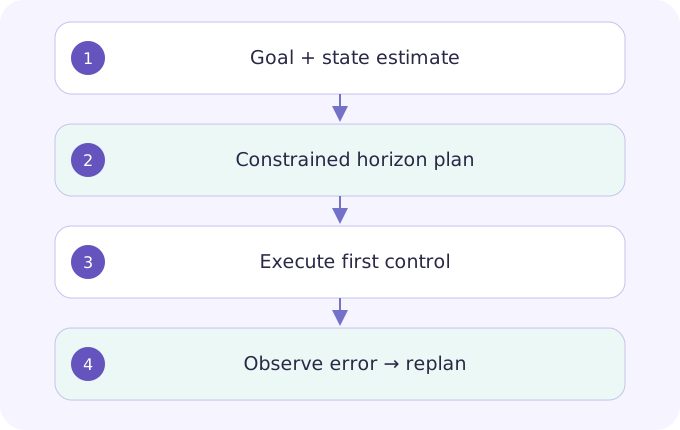
A policy often specifies a target rather than motor torque. A lower-level controller tracks it at a higher rate. Separate planning, tracking and safety responsibilities. Model predictive control optimizes a finite future but executes only the first control before replanning from the next observation. Stability is not implied by low training loss. Latency, saturation and contact can break a controller that looks smooth in a nominal simulation.
Text / 原始公式
u = Kp(x* − x) − Kd v
x_next = x + Δt·v; v_next = v + Δt·u/m
min Σₜ [(xₜ−x*)ᵀQ(xₜ−x*) + uₜᵀRuₜ]
subject to dynamics, state limits and actuator limits
Study guide & lesson outline
LEARNING CONTRACTUnderstand → implement → investigate
Goal: explain the mechanism in this lesson, reproduce one example and test a failure case. Reading alone does not mark mastery.
- Understand: state assumptions, shapes/units and a counterexample.
- Implement: reproduce a numerical example and inspect boundaries.
- Investigate: compare one alternative under a matched budget.
Mechanism map & worked derivation
| Symbol | Meaning |
|---|---|
| Kp, Kd | Proportional and derivative gains |
| Q, R | State-error and control-effort cost weights |
- A 1 kg point mass is at
m, target 1 m, m/s. With N/m and Ns/m, N. - If the actuator limit is 5 N, execution uses 5 N. At
s, explicit Euler predicts v_ m/s and x_ m. - Compare constrained and unconstrained rollouts. Increasing gain may shorten nominal settling time while increasing saturation or delay-induced oscillation.
Sweep delay and mass in a toy simulator. Record overshoot, settling time, peak effort and constraint violations; keep integration step fixed. A simulation pass is not hardware certification.
Original interview exercises & analysis
Answer aloud before revealing the analysis. Add assumptions, a counterexample and a test you would run.
Why replan rather than execute the whole trajectory?
New observations reveal model mismatch and disturbances. Replanning trades compute for correction; its deadline must still fit the control budget.
Can an action clamp prove collision safety?
No. Bounded actions can still move into obstacles. Safety depends on state, stopping distance, geometry and the supervisory system.
Read the primary sources
Underactuated Robotics — Russ Tedrake ↗
Original Token Lab explanations and synthetic calculations; not measured robot performance. Source links checked 2026-10-25. Unversioned arXiv links may change; record a version for reproduction.