1. Why can harder negatives be harmful?
参考解答と評価観点
They may be false negatives or annotation errors. High probability gives them substantial repulsive gradient.
Inspect InfoNCE, temperature and the exact gradient applied to a possible false negative.
ローカル計算と合成データです。有料 API や実モデルのベンチマークは使用しません。技術本文は英語と中国語に対応しています。この言語では英語の技術本文を表示します。
Goal: explain the mechanism in this lesson, reproduce one example and test a failure case. Reading alone does not mark mastery.
前提知識 · Softmax, cross-entropy, derivatives.
The positive is pulled up in similarity while negatives are pushed down by gradient descent. A high-scoring negative gets a stronger push. If that negative is actually relevant, the training signal conflicts with the desired semantics.
L = −log[exp(s₊/τ) / Σⱼ exp(sⱼ/τ)]
∂L/∂sᵢ = (pᵢ − 1[i=positive]) / τ
positive index is zero-based; excluded candidates leave the denominator
Common pitfall: Removing candidates makes the classification task easier; reduced loss alone does not prove improved representation learning.
With 3 equal similarity scores and one positive, what is InfoNCE loss in nats?
−ln(1/3) = ln(3) ≈ 1.098612
Treat index 1 as a known false negative. Run with all candidates, then exclude index 1 and compare its gradient and the positive probability. Sweep temperature 0.05, 0.2 and 1.
Deliver: input configurations, exported results, controlled variables, observations, alternative explanations and the next validation step.
Removing a candidate changes task difficulty. A lower loss after removal cannot establish improved embeddings; evaluate a fixed held-out retrieval task.
実行すると結果が表示されます。
条件を統制して実行結果を比較してください。出力に入力と手法を含みます。
自己評価:仕組みと前提を説明し、仮説を区別できる実験を提案してください。LLM 自動採点はありません。
They may be false negatives or annotation errors. High probability gives them substantial repulsive gradient.
No. The 1/τ factor grows, but softmax probabilities also change and can saturate. Inspect both terms.
Keep encoder, data budget and evaluation fixed, audit negative labels, compare multiple seeds and measure held-out retrieval rather than only training loss.
Exact single-anchor loss and score gradients with supplied similarities; no encoder is trained. The tool cannot identify false negatives automatically. Compare retrieval quality using a separate dataset.
arXiv:1807.03748 · 2018
van den Oord, Li & Vinyals · Year denotes first arXiv submission
Read: Section 2.3: InfoNCE; Appendix A.1: mutual-information argument.
Reading checkpoint: Track the negative-sampling assumptions before interpreting a mutual-information bound.
@misc{arxiv180703748,
  title = {Representation Learning with Contrastive Predictive Coding},
  year = {2018},
  eprint = {1807.03748},
  archivePrefix = {arXiv},
  url = {https://arxiv.org/abs/1807.03748}
}
arXiv:2002.05709 · 2020
Chen et al. · Year denotes first arXiv submission
Read: Framework, augmentation ablations, projection head and contrastive objective.
Reading checkpoint: List which augmentation invariances are useful or harmful for your domain. A lower training loss is not the only evaluation.
@misc{arxiv200205709,
  title = {A Simple Framework for Contrastive Learning of Visual Representations},
  year = {2020},
  eprint = {2002.05709},
  archivePrefix = {arXiv},
  url = {https://arxiv.org/abs/2002.05709}
}Exact single-anchor loss and score gradients with supplied similarities; no encoder is trained. The tool cannot identify false negatives automatically. Compare retrieval quality using a separate dataset.
Objective, derivatives, worked examples and implementation reviewed. A passing finite-difference or manifest check is not a paper reproduction certificate.
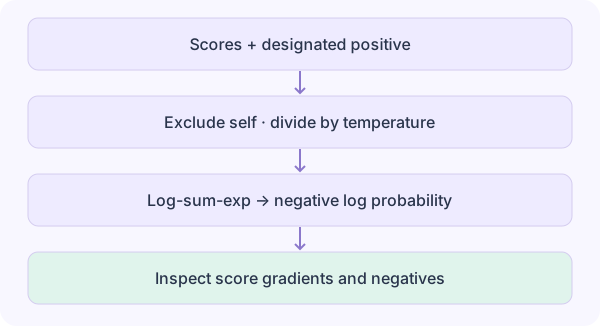
Treat index 1 as a known false negative. Run with all candidates, then exclude index 1 and compare its gradient and the positive probability. Sweep temperature 0.05, 0.2 and 1.
Keep the baseline input fixed, change one parameter or boundary, and compare both the numerical result and the claimed units. A passing example verifies this fixture only.
Save the example and linked modules in one folder. Use Node.js 22 or newer, then run node contrastive-learning.mjs. No third-party runtime dependencies.
import {runPhd} from './phd-core.mjs';
const params={
  "scores": "0.8,0.75,0.2,-0.1",
  "positive": 0,
  "temperature": 0.2,
  "exclude": -1
};
console.log(runPhd('contrastive-learning',params));Treat index 1 as a known false negative. Run with all candidates, then exclude index 1 and compare its gradient and the positive probability. Sweep temperature 0.05, 0.2 and 1.
Record input, code version, expected result and observed result in the notebook below. Then construct a counterexample that violates the assumption above and explain why the original conclusion no longer follows.
Download complete kit (.tar.gz) · Complete reference kit and regression checksBefore revealing an answer, predict one result. After the exercise, record the discrepancy and a transfer test. Saved locally across language editions.
Open notebook / export / clear →The mathematical review scope is recorded per lesson. It does not establish empirical paper reproduction; report suspected errors in your notes. Review scope