Frontier research & engineering experiments
For advanced undergraduates and masters students: connect inference scaling, selective state spaces and diffusion language models. Explain the mechanism, then design a test that could falsify your hypothesis.
This collection uses representative 2023–2026 papers as foundations for active research directions, not an exhaustive latest leaderboard. Numeric examples are original teaching calculations; experiment protocols require implementation.
Robot recovery: when retrying helps, and when it hides failure
Read Backtrack, DexPort and ViT-H through a practical lens: frozen policies, action labels, executable motion and bounded recovery. Includes a local state-machine experiment.
Self-improving agents: reward gains are not capability gains →
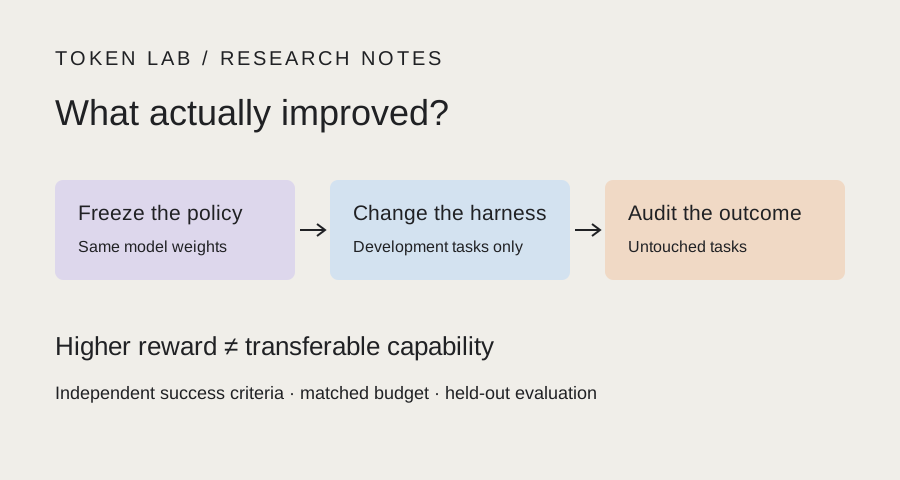
A research reading guide and local experiment on adaptive harnesses, reward collapse, frozen-policy comparisons and held-out evaluation.
From LLM Calls to Agent Harnesses →
An English reading brief with an original local experiment: context, tool permissions, budgets, checkpoints and seven executable checks.
Test-time compute: search, verification and budgets →
Prerequisites: probability, evaluation and inference cost. Learn when more attempts help and when a verifier becomes the bottleneck.
Selective state spaces: Mamba and sequence memory →
Prerequisites: linear algebra, recurrence and attention. Compare compressed state with explicit token retrieval.
Diffusion language models: masking and iterative decoding →
Prerequisites: cross-entropy, Transformers and generative modeling. Understand LLaDA-style masked generation without equating parallelism with speed.
Research foundations & paper deep dives
Representative papers behind active engineering and research directions; selected for learning, not ranked by publication date.
DeepSeek-R1: rewards, reasoning and what the evidence establishes →
Study R1-Zero and R1 separately, then build a controlled test of reasoning improvement. This analysis is pinned to arXiv v1.
LLM-as-a-judge: evaluate the evaluator →
Separate answer preference from correctness and reveal how order effects can alter a reported win rate.
DPO: preference learning through relative log probabilities →
Derive the pairwise margin and see what β changes in a single preference example.
FlashAttention: optimize data movement before counting FLOPs →
See why not storing an attention matrix can matter as much as arithmetic, and reconstruct softmax one tile at a time.
Shared experiment report
Record paper, model and data versions, seeds, hardware, budgets, baselines, ablations and confidence intervals. Separate paper claims, your measurements and untested hypotheses. Fix the hypothesis and stopping rule before tuning.