SFT → RLHF → DPO: different training signals
Choose the signal that matches the available feedback.
Detailed technical articles are available in English and Chinese. This locale shows the English article with localized navigation.
Study guide & lesson outline
LEARNING CONTRACTUnderstand → implement → investigate
Goal: explain the mechanism in this lesson, reproduce one example and test a failure case. Reading alone does not mark mastery.
- Understand: state assumptions, shapes/units and a counterexample.
- Implement: reproduce a numerical example and inspect boundaries.
- Investigate: compare one alternative under a matched budget.
Understand the mechanism
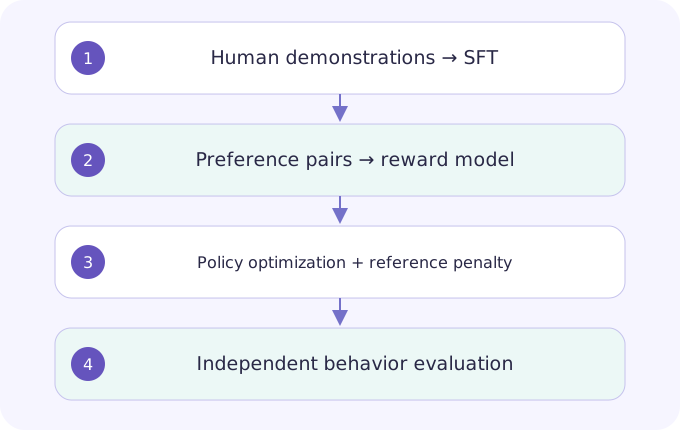
SFT learns from demonstrations of desired outputs. A common RLHF pipeline fits a reward model from preferences and optimizes a policy with a reference penalty. DPO instead uses pairwise preferences and reference log probabilities directly in its loss. DPO is preference optimization, not an online environment-interaction loop simply because it is related to an RL objective.
Text / 原始公式
SFT: −log πθ(y_demo|x)
RLHF: E[rφ(x,y)]−β KL(πθ||πref)
DPO: −log σ(βΔ_log-ratio)
Mechanism map & worked derivation
| Symbol | Meaning |
|---|---|
| rφ | Learned reward proxy |
| πref | Reference policy for the drift penalty |
| β | Trade-off coefficient under the stated convention |
- Distinguish three data products: demonstrations for SFT, comparisons for reward learning, and sampled trajectories for policy optimization. They are not interchangeable labels.
- For two policies on the same prompt distribution, (expected reward, expected KL)=(1,0.4) and (0.8,0.1),
gives regularized values 0.6 and 0.7. A lower raw reward can win after the drift penalty. - Evaluate the selected policy with independent task labels and blinded human comparisons. Otherwise reward-model errors can become both the training target and the apparent success criterion.
Report who labeled the data and which prompt distribution was evaluated. A single reward score cannot represent every user objective.
Original exercise & analysis
Use the same held-out prompts to compare a base model, SFT checkpoint and preference-tuned checkpoint. Control generation settings and response length. Audit helpfulness, factuality and refusal separately; a single overall preference score can hide regressions.
Human preference is neither a perfect truth label nor a universal representation of all users.
Can RLHF improve behavior without increasing parameter count?
Yes. Optimization changes the distribution of outputs under the model. That is a change in behavior on an evaluation distribution, not evidence that every capability improved.