低成本模型故障
Every request pays both cost and latency before successful fallback.
本地计算 / 模拟本地教学实验,不调用外部 API。合成示例不能替代生产环境测量。
学习指南与本课目录
LEARNING CONTRACT理解 → 实现 → 研究
目标:解释本课机制、复现一个例子、测试一个失败案例。读完不自动代表掌握。
- 理解层:写明假设、形状/单位和一个反例。
- 实现层:复算数值例子并检查边界。
- 研究层:在匹配预算下比较一个替代方法。
02 · 预测与配置
技术场景说明、参数名称与参考答案目前为英文。
03 · 检查证据
方法与参考资料
Analytical expectation with user-supplied synthetic per-request prices and latencies, not current provider rates. Sequential one-time fallback; failed primary attempts are charged; fallback always succeeds. No quality prediction, queueing, correlated failures or tail-latency model.
Text / 原始公式
E[C]=s(Ccheap+f×Cstrong)+(1−s)Cstrong; E[T]=s(Tcheap+f×Tstrong)+(1−s)Tstrong
A cheaper route may violate task-quality requirements; this estimator does not measure quality.
AWS Builders Library · timeouts, retries and backoff ↗练习题
routing-4 / 01What does “Cheap model outage” test?
Every request pays both cost and latency before successful fallback.
Original teaching answer / local derivation. Method reference: AWS Builders Library · timeouts, retries and backoff ↗
打开实验 →routing-4 / 02Which computation produces the result in “Cheap model outage”?
E[C]=s(Ccheap+f×Cstrong)+(1−s)Cstrong; E[T]=s(Tcheap+f×Tstrong)+(1−s)Tstrong
Original teaching answer / local derivation. Method reference: AWS Builders Library · timeouts, retries and backoff ↗
打开实验 →routing-4 / 03What is the baseline configuration for “Cheap model outage”?
{"requests":1000,"cheap":1,"failure":1,"cheapCost":0.001,"strongCost":0.02,"cheapMs":200,"strongMs":1000}
Original teaching answer / local derivation. Method reference: AWS Builders Library · timeouts, retries and backoff ↗
打开实验 →routing-4 / 04What numerical result should you check for “Cheap model outage”?
{"Expected USD/request":0.021,"Expected total USD":21,"Expected latency (ms)":1200,"Fallback calls":1000}
Original teaching answer / local derivation. Method reference: AWS Builders Library · timeouts, retries and backoff ↗
打开实验 →routing-4 / 05How would you run a controlled comparison for “Cheap model outage”?
Keep the supplied fixture and other settings fixed; change failure. Compare expected cost, mean latency and fallback volume with observed production traces.
Original teaching answer / local derivation. Method reference: AWS Builders Library · timeouts, retries and backoff ↗
打开实验 →routing-4 / 06What failure could invalidate a conclusion from “Cheap model outage”?
A cheaper route may violate task-quality requirements; this estimator does not measure quality.
Original teaching answer / local derivation. Method reference: AWS Builders Library · timeouts, retries and backoff ↗
打开实验 →routing-4 / 07Is “Cheap model outage” a benchmark of a deployed language model?
No. Analytical expectation with user-supplied synthetic per-request prices and latencies, not current provider rates. Sequential one-time fallback; failed primary attempts are charged; fallback always succeeds. No quality prediction, queueing, correlated failures or tail-latency model.
Original teaching answer / local derivation. Method reference: AWS Builders Library · timeouts, retries and backoff ↗
打开实验 →routing-4 / 08Which evidence should you report for “Cheap model outage”?
Compare expected cost, mean latency and fallback volume with observed production traces. Export inputs, engine, result and method; distinguish synthetic fixtures from observed production data.
Original teaching answer / local derivation. Method reference: AWS Builders Library · timeouts, retries and backoff ↗
打开实验 →routing-4 / 09How can another researcher reproduce “Cheap model outage”?
Open routing-4, reset the preset, retain the exact inputs and run. The calculation is deterministic for identical inputs.
Original teaching answer / local derivation. Method reference: AWS Builders Library · timeouts, retries and backoff ↗
打开实验 →routing-4 / 10What is the next validation step after “Cheap model outage”?
A cheaper route may violate task-quality requirements; this estimator does not measure quality. Test the hypothesis on a representative held-out workload and document a baseline, success metric and stopping rule before claiming deployment readiness.
Original teaching answer / local derivation. Method reference: AWS Builders Library · timeouts, retries and backoff ↗
打开实验 →假设、参考实现与验收
失败的便宜调用仍计费,假设 fallback 成功。期望延迟按串行计算且忽略排队;总体期望不是 p95 延迟。
已复核引擎公式、场景预设及数值保护。固定种子的合成输入不是生产基准。
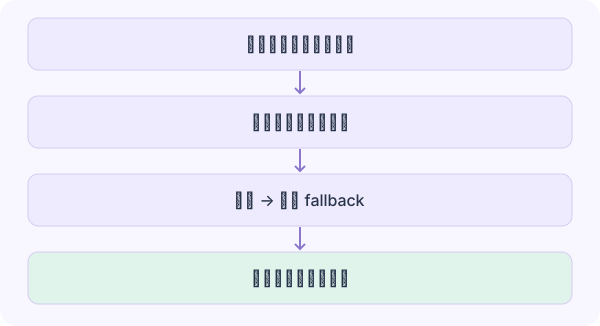
运行前:预测一个边界情况
Every request pays both cost and latency before successful fallback.
提示:隔离假设
固定基线输入,只改变一个参数或边界;同时比较数值与声明单位。单例通过仅验证该样例。
最小可运行算例
将算例及所链接模块保存在同一目录。使用 Node.js 22 或更高版本,然后运行 node routing-4.mjs. 无需第三方运行依赖。
import {calculate,network} from './academy-core.mjs';
const params={
  "requests": 1000,
  "cheap": 1,
  "failure": 1,
  "cheapCost": 0.001,
  "strongCost": 0.02,
  "cheapMs": 200,
  "strongMs": 1000
};
const result=calculate('routing',params);
console.log(result.metrics);测试与迁移
Every request pays both cost and latency before successful fallback.
在下方笔记记录输入、代码版本、期望值和实测值;再构造违反上述假设的反例,解释原结论为何不再成立。
下载完整代码包(.tar.gz) · 完整参考代码与回归检查预测、检验与证据记录
展开答案前先预测一个结果;练习后记录差异和迁移测试。记录仅存本地,在不同语言版本间共用。
打开记录/导出/清除 →数学复核范围逐篇记录,不代表完成论文实证复现;可在笔记中记录疑似错误。 复核范围