Tokens y tokenizadores: del texto a la entrada del modelo
Entiende qué representa un token, observa una codificación real y comprueba la reconstrucción del texto.
Un token no es una palabra
El modelo recibe IDs de tokens. El tokenizador transforma el texto en enteros mediante un vocabulario y reglas de codificación. Una palabra frecuente puede ocupar un token; un nombre poco común, varios. Los espacios, los signos y los saltos de línea también cuentan.
BPE forma unidades de subpalabras mediante reglas de combinación aprendidas. Los fragmentos visibles sirven para depurar, no para analizar lingüísticamente una frase.
Study guide & lesson outlineLEARNING CONTRACT
Understand → implement → investigate
Goal: explain the mechanism in this lesson, reproduce one example and test a failure case. Reading alone does not mark mastery.
Understand: state assumptions, shapes/units and a counterexample.
Implement: reproduce a numerical example and inspect boundaries.
Investigate: compare one alternative under a matched budget.
Ejecuta un ejemplo reproducible
Elige cl100k_base e introduce exactamente Hello, world!, con coma y espacio. Obtendrás cuatro IDs: 9906, 11, 1917, 0. Selecciona cada bloque de color. Después elimina la coma o cambia las mayúsculas y observa el resultado.
Al pasar a o200k_base cambia el vocabulario, por lo que pueden cambiar los IDs y el recuento. Un ID solo tiene sentido junto con su codificación. Exporta ambos.
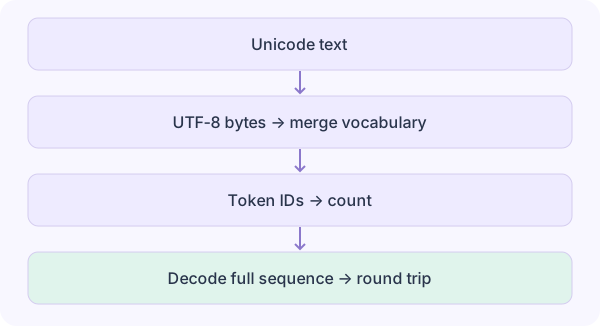
Decodifica toda la secuencia y compárala con el original. Un token puede dividir un carácter UTF-8 y mostrarse como � por separado, aunque la secuencia completa se reconstruya correctamente.
Este contador procesa texto, no una solicitud API completa. Roles, definiciones de herramientas y medios pueden añadir uso. Contrasta el resultado local con la respuesta de la API antes de aplicarlo a facturación o límites estrictos.
Round-trip decode(encode(text)) equals the original text. Individual tokens may split UTF-8 sequences; do not require each token to decode independently.
Shared code, English mathematical explanation and key multilingual numeric passages reviewed. This is not a full translation proofread.
Mechanism map: follow the transformations from top to bottom.
Before running: predict a boundary case
Round-trip decode(encode(text)) equals the original text. Individual tokens may split UTF-8 sequences; do not require each token to decode independently.
Hint: isolate the assumption
Keep the baseline input fixed, change one parameter or boundary, and compare both the numerical result and the claimed units. A passing example verifies this fixture only.
Minimal executable example
Save the example and linked modules in one folder. Use Node.js 22 or newer, then run node tokens-and-tokenizers.mjs. npm install gpt-tokenizer@4.1.0
Round-trip decode(encode(text)) equals the original text. Individual tokens may split UTF-8 sequences; do not require each token to decode independently.
Record input, code version, expected result and observed result in the notebook below. Then construct a counterexample that violates the assumption above and explain why the original conclusion no longer follows.
Before revealing an answer, predict one result. After the exercise, record the discrepancy and a transfer test. Saved locally across language editions.
The mathematical review scope is recorded per lesson. It does not establish empirical paper reproduction; report suspected errors in your notes. Review scope