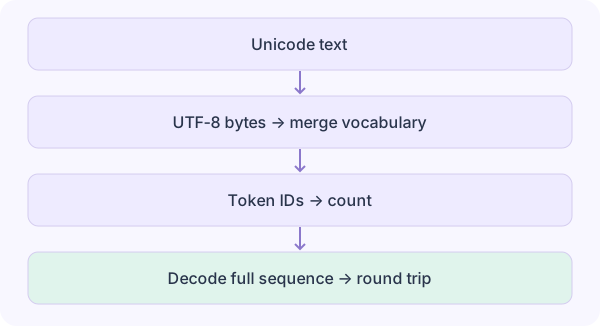
Round-trip decode(encode(text)) equals the original text. Individual tokens may split UTF-8 sequences; do not require each token to decode independently.
Shared code, English mathematical explanation and key multilingual numeric passages reviewed. This is not a full translation proofread.
Mechanism map: follow the transformations from top to bottom.
Before running: predict a boundary case
Round-trip decode(encode(text)) equals the original text. Individual tokens may split UTF-8 sequences; do not require each token to decode independently.
Hint: isolate the assumption
Keep the baseline input fixed, change one parameter or boundary, and compare both the numerical result and the claimed units. A passing example verifies this fixture only.
Minimal executable example
Save the example and linked modules in one folder. Use Node.js 22 or newer, then run node tokens-and-tokenizers.mjs. npm install gpt-tokenizer@4.1.0
Round-trip decode(encode(text)) equals the original text. Individual tokens may split UTF-8 sequences; do not require each token to decode independently.
Record input, code version, expected result and observed result in the notebook below. Then construct a counterexample that violates the assumption above and explain why the original conclusion no longer follows.
Before revealing an answer, predict one result. After the exercise, record the discrepancy and a transfer test. Saved locally across language editions.
The mathematical review scope is recorded per lesson. It does not establish empirical paper reproduction; report suspected errors in your notes. Review scope