1. Why can LoRA start with a zero update without getting stuck?
参考解答と評価観点
Make one factor zero and the other nonzero. Their product is zero, but the zero factor can receive a nonzero gradient.
Train low-rank factors, compare an analytical capacity bound, and inspect initialization failure.
ローカル計算と合成データです。有料 API や実モデルのベンチマークは使用しません。技術本文は英語と中国語に対応しています。この言語では英語の技術本文を表示します。
Goal: explain the mechanism in this lesson, reproduce one example and test a failure case. Reading alone does not mark mastery.
前提知識 · Matrix multiplication, rank, singular values, gradients.
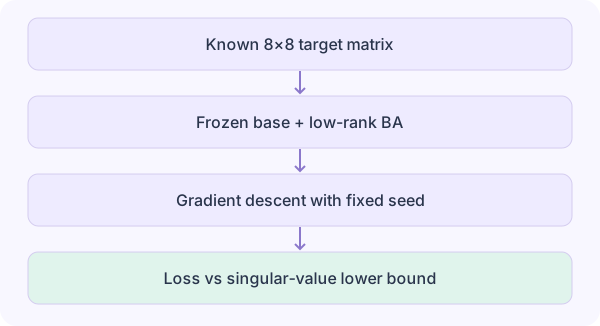
A low-rank update restricts the space of possible changes. The experiment fits a known 8×8 target with singular values [5,3,1,0.3,0,0,0,0]. The rank-r optimum has loss equal to the sum of discarded squared singular values divided by 128.
ΔW = BA; A∈R^(r×d), B∈R^(d×r)
trainable parameters = 2dr (vs d²)
L = ||BA−T||²_F / (2×8²)
∇B = (BA−T)Aᵀ/64; ∇A = Bᵀ(BA−T)/64
Common pitfall: Equal optimizer steps across ranks do not imply equal FLOPs; low matrix reconstruction loss does not establish downstream language-model quality.
For a 4096×4096 layer and rank 8, how many parameters are in A and B together?
4096×8 + 8×4096 = 65,536; 0.390625% of 4096²
Compare rank 1,2,4 with identical seed and steps. Then initialize both factors to zero. Separate the theoretical rank limit from failure to reach that limit during optimization.
Deliver: input configurations, exported results, controlled variables, observations, alternative explanations and the next validation step.
If both A and B are zero, both gradients are zero. Random A with zero B gives a zero initial update but a nonzero first gradient for B.
実行すると結果が表示されます。
条件を統制して実行結果を比較してください。出力に入力と手法を含みます。
自己評価:仕組みと前提を説明し、仮説を区別できる実験を提案してください。LLM 自動採点はありません。
Make one factor zero and the other nonzero. Their product is zero, but the zero factor can receive a nonzero gradient.
Not alone. Compare compute, parameter budget, tuning budget and uncertainty; capacity and optimization can both change.
It isolates representational limits for this known matrix. A remaining gap may reflect optimization, and does not predict LLM task quality.
Actual local matrix optimization, not fine-tuning a language model. Frozen base
arXiv:2106.09685 · 2021
Hu et al. · Year denotes first arXiv submission
Read: Low-rank parameterization, initialization and rank investigations.
Reading checkpoint: Derive parameter count and the first update when B=0; distinguish the toy matrix experiment from language-model fine-tuning.
@misc{arxiv210609685,
  title = {LoRA: Low-Rank Adaptation of Large Language Models},
  year = {2021},
  eprint = {2106.09685},
  archivePrefix = {arXiv},
  url = {https://arxiv.org/abs/2106.09685}
}
arXiv:2305.14314 · 2023
Dettmers et al. · Year denotes first arXiv submission
Read: Frozen quantized backbone, NF4, double quantization and paged optimizers.
Reading checkpoint: Make separate memory accounts for weights, adapters, optimizer states and activations. The site does not execute QLoRA.
@misc{arxiv230514314,
  title = {QLoRA: Efficient Finetuning of Quantized LLMs},
  year = {2023},
  eprint = {2305.14314},
  archivePrefix = {arXiv},
  url = {https://arxiv.org/abs/2305.14314}
}Actual local matrix optimization, not fine-tuning a language model. Frozen base
Objective, derivatives, worked examples and implementation reviewed. A passing finite-difference or manifest check is not a paper reproduction certificate.
Compare rank 1,2,4 with identical seed and steps. Then initialize both factors to zero. Separate the theoretical rank limit from failure to reach that limit during optimization.
Keep the baseline input fixed, change one parameter or boundary, and compare both the numerical result and the claimed units. A passing example verifies this fixture only.
Save the example and linked modules in one folder. Use Node.js 22 or newer, then run node lora-rank.mjs. No third-party runtime dependencies.
import {runPhd} from './phd-core.mjs';
const params={
  "rank": 2,
  "rate": 0.8,
  "epochs": 1000,
  "seed": 42,
  "dimension": 4096,
  "zeroBoth": 0
};
console.log(runPhd('lora-rank',params));Compare rank 1,2,4 with identical seed and steps. Then initialize both factors to zero. Separate the theoretical rank limit from failure to reach that limit during optimization.
Record input, code version, expected result and observed result in the notebook below. Then construct a counterexample that violates the assumption above and explain why the original conclusion no longer follows.
Download complete kit (.tar.gz) · Complete reference kit and regression checksBefore revealing an answer, predict one result. After the exercise, record the discrepancy and a transfer test. Saved locally across language editions.
Open notebook / export / clear →The mathematical review scope is recorded per lesson. It does not establish empirical paper reproduction; report suspected errors in your notes. Review scope