01 · Frames, transformations and robot kinematics
Translate a camera observation into a robot command without losing frame, unit or rotation conventions.
Prerequisites: Vectors, matrix multiplication, radians.
Technical posts currently have English and Chinese editions. This locale displays the English article with localized navigation.
Understand the mechanism
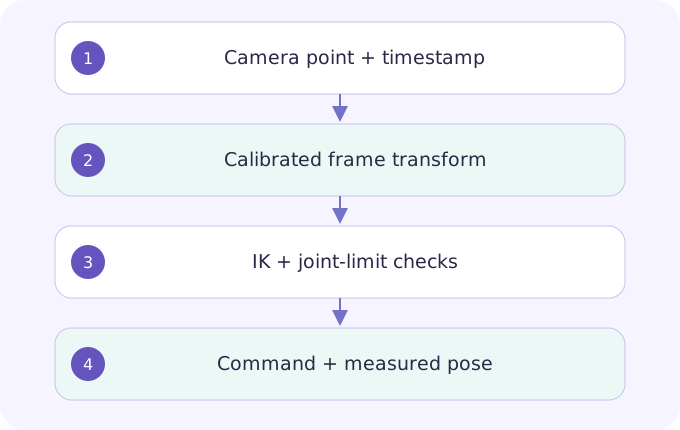
A perception model returns numbers in a frame, not an absolute location. Declare T_AB as the transform that maps coordinates from B to A. Composition then cancels adjacent frame labels. Forward kinematics maps joint positions to tool pose; inverse kinematics solves for joints and can have multiple solutions or none. A Jacobian is a local velocity map, not a globally valid inverse. Near a singularity, a small desired tool velocity can require excessive joint velocity.
Text / 原始公式
p_A = R_AB p_B + t_AB
T_AC = T_AB T_BC;  T_AB⁻¹ = [R_ABᵀ, −R_ABᵀt_AB; 0, 1]
x = l₁ cos q₁ + l₂ cos(q₁+q₂)
y = l₁ sin q₁ + l₂ sin(q₁+q₂)
Study guide & lesson outline
LEARNING CONTRACTUnderstand → implement → investigate
Goal: explain the mechanism in this lesson, reproduce one example and test a failure case. Reading alone does not mark mastery.
- Understand: state assumptions, shapes/units and a counterexample.
- Implement: reproduce a numerical example and inspect boundaries.
- Investigate: compare one alternative under a matched budget.
Mechanism map & worked derivation
| Symbol | Meaning |
|---|---|
| R, t | Rotation matrix and translation in metres |
| q, l | Joint angles in radians and link lengths |
- Let camera point p_
,0,0) m, R_BC be a +90° rotation about z, and t_ ,0,0) m. Rotate first: (0,1,0). Then translate: p_ ,1,0). - Apply the inverse: subtract translation before rotating back. Recover (1,0,0). A round-trip test catches incorrect inverse translation.
- For a two-link arm with
=1, and , the tip is (1,1). At the arm is straight and the planar Jacobian loses rank.
Implement forward/inverse transforms and finite-difference Jacobians. Save round-trip error, unit tests and a singularity plot. Test degrees/radians and wrong frame order deliberately.
Original interview exercises & analysis
Answer aloud before revealing the analysis. Add assumptions, a counterexample and a test you would run.
Why is a correct grasp pixel not enough?
Depth, camera calibration, extrinsics, tool offset and synchronization can each be wrong. Trace a known calibration point through every transform before retraining the policy.
How do you handle unreachable IK targets?
Report infeasibility, preserve joint limits, and use a bounded fallback. Do not silently send a large least-squares solution to hardware.
Read the primary sources
Modern Robotics — Lynch & Park ↗
Original Token Lab explanations and synthetic calculations; not measured robot performance. Source links checked 2026-10-25. Unversioned arXiv links may change; record a version for reproduction.